
Received a USCIS Request for Evidence (RFE)? Here’s What It Means and What You Should Do Next

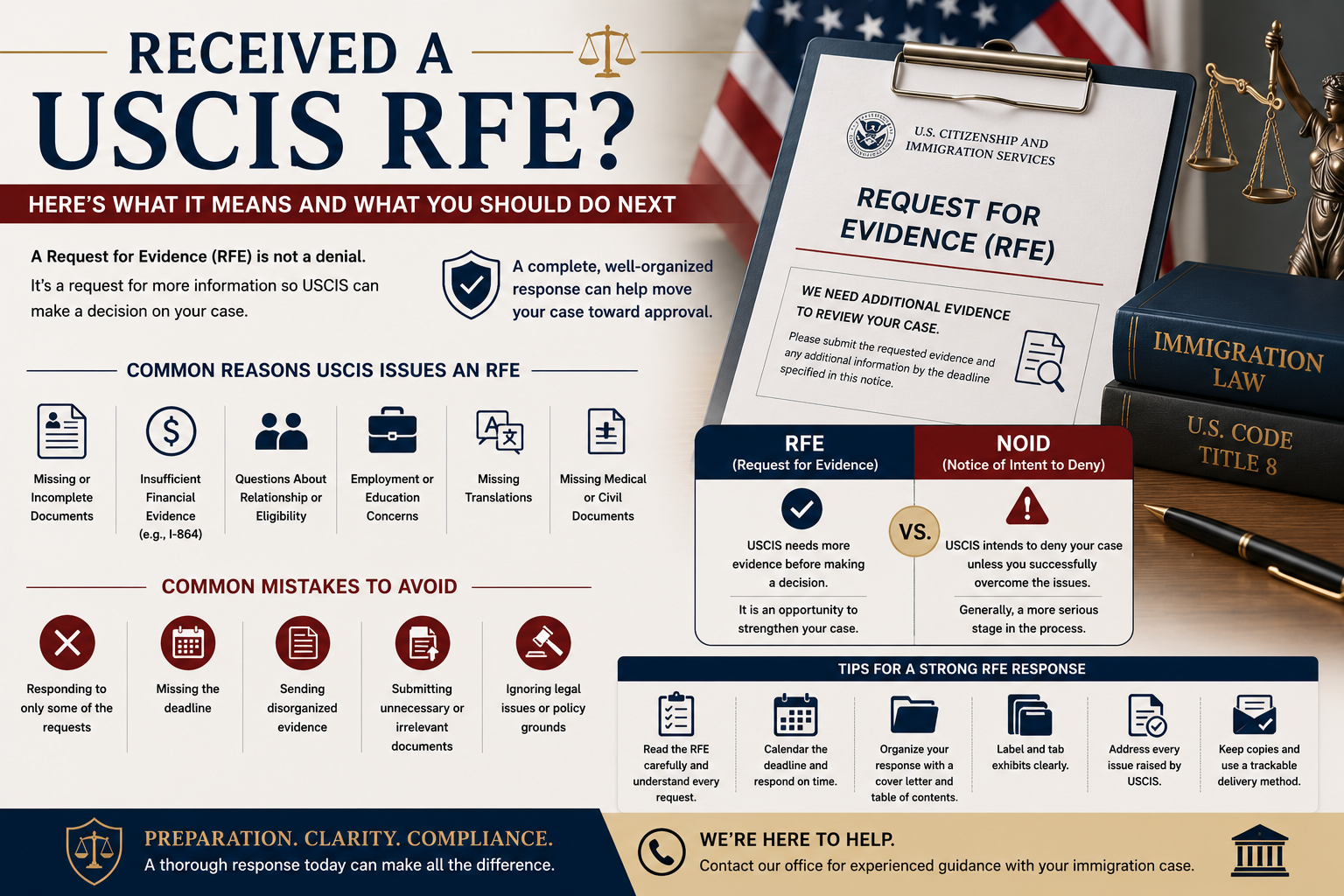
Opening your mailbox and finding a Request for Evidence (RFE) from U.S. Citizenship and Immigration Services (USCIS) can be unsettling. Many applicants immediately assume that something has gone seriously wrong or that their application is about to be denied.
Fortunately, that is often not the case.
In many situations, an RFE simply means that the USCIS officer needs additional information or documentation before making a decision on your case. An RFE is an opportunity to address questions or deficiencies in the record—it is not, by itself, a denial of your application.
That said, how you respond to an RFE can significantly affect the outcome of your case. A thorough, organized, and timely response may help move your application toward approval, while an incomplete or late response may result in a denial.
What Is a Request for Evidence?
A Request for Evidence (RFE) is a formal notice issued by USCIS requesting additional evidence needed to determine whether an applicant has established eligibility for the immigration benefit sought.
USCIS may issue an RFE when the initial filing does not contain sufficient evidence to approve the application, but the officer believes the deficiency may be corrected through additional documentation. See 8 C.F.R. § 103.2(b)(8).
An RFE does not necessarily mean that USCIS believes the application lacks merit. In many cases, it simply reflects that additional evidence is needed before a final decision can be made.
Why Does USCIS Issue RFEs?
Every immigration benefit has specific statutory and regulatory eligibility requirements.
If USCIS determines that the existing record does not establish eligibility by a preponderance of the evidence, the officer may request additional documentation.
Common reasons include:
- Missing civil documents;
- Insufficient financial evidence on Form I-864;
- Questions regarding lawful status;
- Incomplete responses on immigration forms;
- Missing translations;
- Questions regarding employment history;
- Insufficient evidence of a bona fide marriage;
- Missing medical examination reports;
- Questions regarding maintenance of nonimmigrant status;
- Missing birth or marriage certificates;
- Insufficient evidence supporting an employment-based petition.
In many cases, the problem is not that the applicant is ineligible—it is simply that USCIS needs additional documentation.
Does Receiving an RFE Mean My Case Will Be Denied?
No.
In fact, many applications are approved after a well-prepared RFE response.
An RFE generally indicates that USCIS believes the deficiency may be curable.
However, applicants should not become complacent.
An incomplete response, failure to address every issue raised, or failure to respond before the deadline may result in a denial.
Read the RFE Carefully
One of the biggest mistakes applicants make is responding to only part of the RFE.
Every RFE should be read carefully from beginning to end.
Ask yourself:
- What exactly is USCIS requesting?
- Which eligibility requirement is USCIS questioning?
- What evidence would best answer that question?
- Is USCIS requesting documents, explanations, or both?
A successful response addresses every issue identified by the officer.
Common Mistakes When Responding to an RFE
1. Responding to Only Some of the Requests
Applicants sometimes provide documents they think are important while overlooking documents specifically requested by USCIS.
Always respond directly to every request contained in the notice.
2. Missing the Deadline
Every RFE contains a response deadline.
USCIS generally decides the case based on the existing record if no timely response is received.
Late responses are typically not accepted.
3. Sending Disorganized Evidence
Hundreds of pages of unsorted documents may not strengthen a case.
Instead, organize your response.
A well-prepared response typically includes:
- Cover letter;
- Table of contents;
- Legal explanation (when appropriate);
- Tabbed exhibits;
- Clearly labeled supporting documents.
Making the officer’s job easier can improve the efficiency of the review process.
4. Assuming More Documents Are Always Better
Quality is often more important than quantity.
Submitting hundreds of irrelevant pages may distract from the evidence that actually establishes eligibility.
Every document included should help answer a question raised in the RFE.
5. Ignoring Legal Issues
Sometimes an RFE raises more than a factual question.
The issue may involve interpretation of a statute, regulation, or USCIS policy.
In those situations, a legal brief citing applicable statutes, regulations, the USCIS Policy Manual, and relevant case law may significantly strengthen the response.
Can USCIS Issue More Than One RFE?
Sometimes.
Although USCIS generally seeks to request all missing evidence at one time, there are circumstances in which additional RFEs may be issued.
Applicants should not assume that an initial RFE identifies every possible issue in the case.
What’s the Difference Between an RFE and a NOID?
Applicants frequently confuse a Request for Evidence (RFE) with a Notice of Intent to Deny (NOID).
The difference is important.
Request for Evidence (RFE)
USCIS needs additional evidence before making a decision.
The officer has not yet determined that the application should be denied.
Notice of Intent to Deny (NOID)
A NOID is generally more serious.
It means USCIS has reviewed the evidence and intends to deny the application unless the applicant successfully overcomes the stated grounds for denial.
Although both notices require prompt attention, a NOID usually indicates that the officer has reached a preliminary adverse conclusion.
Should You Submit More Than USCIS Requested?
Sometimes—but strategically.
If additional evidence directly addresses the issue raised or strengthens eligibility, it may be appropriate to include it.
However, applicants should avoid overwhelming USCIS with unnecessary or unrelated documents.
An organized and focused submission is generally more effective than an overly voluminous one.
Practical Tips for Responding to an RFE
✓ Read every page carefully.
✓ Calendar the response deadline immediately.
✓ Gather all requested documents before preparing the response.
✓ Organize the evidence logically.
✓ Clearly label exhibits.
✓ Address every issue raised by USCIS.
✓ Keep complete copies of everything submitted.
✓ Use a reliable delivery method with tracking.
Final Thoughts
Receiving a Request for Evidence is not necessarily a setback. In many cases, it is simply part of the adjudication process and provides an opportunity to strengthen the record before USCIS reaches a final decision.
The key is to treat the RFE seriously. A complete, organized, and persuasive response that directly addresses the officer’s concerns can often make the difference between approval and denial.
If you have received an RFE and are unsure how to respond, obtaining legal advice before submitting your response may help ensure that every issue is properly addressed and that your application is presented in the strongest possible light.