
You’ve Been Served With a Lawsuit in California—Now What? A Practical Guide to Protecting Your Rights

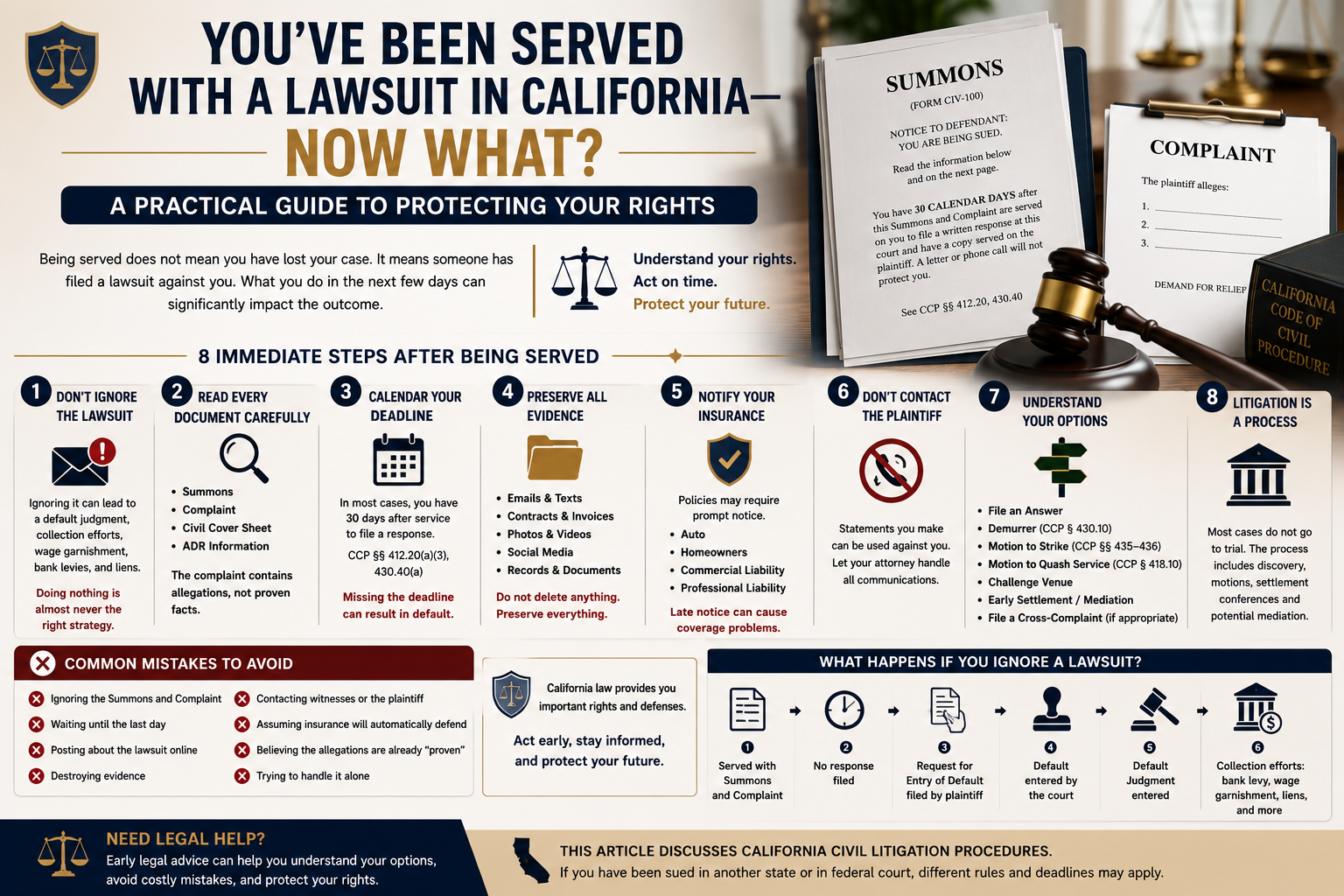
Being served with a lawsuit can be one of the most stressful experiences a person or business owner faces. Whether the lawsuit arises from a personal injury claim, a contract dispute, a landlord-tenant matter, a business disagreement, or another civil dispute, the immediate reaction is often the same: “What do I do now?”
The first thing to understand is that being served with a lawsuit does not mean you have lost your case. It simply means that another party has asked a California court to resolve a legal dispute. At this stage, the allegations contained in the complaint are merely allegations—they have not yet been proven.
What you do next, however, can have a significant impact on the outcome of your case. California law imposes strict procedural deadlines, and failing to respond appropriately may result in a default judgment that could have been avoided.
This article provides a general overview of the California civil litigation process and discusses the practical steps you should consider after being served with a lawsuit.
Important: This article discusses California civil litigation procedures. If you have been sued in another state or in federal court, different procedural rules and deadlines may apply.
Step 1: Stay Calm—Being Served Is Not a Judgment Against You
Many people mistakenly believe that receiving a Summons and Complaint means the court has already decided the case.
That is not how the legal system works.
A lawsuit begins when one party files a complaint alleging facts that, if proven, would entitle that party to relief. The filing of a lawsuit does not establish liability, nor does it mean the plaintiff will ultimately prevail.
California courts decide civil cases only after both parties have had an opportunity to present their evidence, raise legal defenses, and be heard.
The most important thing you can do after being served is to avoid panic and begin addressing the lawsuit promptly.
Step 2: Read Every Document Carefully
When you are served, you will usually receive several documents.
The two most important are:
- Summons
- Complaint
The Summons advises you that a lawsuit has been filed and informs you that you must file a written response within the time allowed by law.
The Complaint sets forth the plaintiff’s factual allegations and legal causes of action.
Read each page carefully.
Pay close attention to:
- the identity of the plaintiff;
- the court in which the lawsuit was filed;
- the case number;
- the causes of action asserted against you; and
- the date and manner of service.
Understanding precisely what the plaintiff is alleging is the first step toward preparing an effective response.
Step 3: Do Not Miss Your Deadline to Respond
One of the most important deadlines in California civil litigation is the time for filing a responsive pleading.
Generally, a defendant must serve and file a responsive pleading within 30 days after being served with the Summons and Complaint, unless the court orders otherwise or the parties agree to an extension. See California Code of Civil Procedure sections 412.20(a)(3) and 430.40(a). However, your time to respond may differ in certain situations and it is best to consult with a California-licensed attorney to understand your timelines and options.
Failing to respond within the applicable time may allow the plaintiff to request that the court enter your default.
Once default is entered, your ability to defend the lawsuit may become significantly more limited.
For this reason, it is important to determine your response deadline as soon as you are served.
Step 4: Preserve All Evidence
One of the biggest mistakes defendants make is assuming they can “clean up” documents before speaking with an attorney.
Do not destroy, alter, or delete evidence.
Instead, preserve everything that may relate to the dispute, including:
- contracts;
- emails;
- text messages;
- photographs;
- invoices;
- receipts;
- business records;
- medical records, where applicable;
- social media posts;
- surveillance footage; and
- electronically stored information.
California law imposes obligations regarding the preservation of relevant evidence. Destroying evidence after litigation has begun—or when litigation is reasonably anticipated—may result in significant legal consequences, including evidentiary sanctions or adverse inferences.
Step 5: Notify Your Insurance Company Immediately
Many lawsuits are covered, at least in part, by insurance.
Depending upon the nature of the claim, coverage may exist under:
- automobile insurance;
- homeowner’s insurance;
- commercial general liability insurance;
- professional liability (errors and omissions) insurance;
- directors and officers (D&O) insurance;
- employment practices liability insurance; or
- other specialized policies.
Many insurance policies require prompt notice of claims and lawsuits.
Failing to notify your insurance carrier in a timely manner could jeopardize your coverage or delay the appointment of defense counsel.
If you believe insurance may apply, notify your carrier as soon as possible.
Step 6: Resist the Urge to Contact the Plaintiff
After receiving a lawsuit, many people immediately want to call the plaintiff and “clear up the misunderstanding.”
While that reaction is understandable, it is often not advisable.
Statements made after litigation begins may later become evidence in the case.
Depending upon the circumstances, even well-intentioned communications may complicate settlement negotiations or adversely affect your legal position.
Before discussing the lawsuit with the opposing party, consider consulting with an attorney regarding the best course of action.
Step 7: Understand That You Have Several Options
Many defendants assume their only choice is to deny everything and prepare for trial.
California law provides several possible procedural responses depending upon the facts of the case.
These may include:
- filing an Answer responding to the allegations;
- filing a Demurrer where the complaint fails to state facts sufficient to constitute a cause of action (see CCP § 430.10);
- filing a Motion to Strike improper allegations or requests for relief (see CCP §§ 435–436);
- filing a Motion to Quash Service of Summons where service or personal jurisdiction is defective (see CCP § 418.10);
- asserting affirmative defenses;
- filing a Cross-Complaint, where appropriate;
- negotiating an early settlement; or
- participating in mediation or other forms of alternative dispute resolution.
The appropriate strategy depends upon the facts of each case and should be evaluated carefully.
Step 8: Remember That Most Lawsuits Do Not Go to Trial
Many people imagine that being sued means they will soon find themselves in a courtroom before a jury.
In reality, most civil cases resolve before trial.
During litigation, the parties exchange evidence through discovery, take depositions, evaluate the strengths and weaknesses of their positions, and often participate in settlement discussions or mediation.
Preparing every case thoroughly for trial frequently creates opportunities for meaningful settlement before trial becomes necessary.
Common Mistakes Defendants Make
Some of the most common—and avoidable—mistakes include:
- Ignoring the Summons and Complaint.
- Waiting until the last day to seek legal advice.
- Missing the deadline to respond.
- Destroying or deleting evidence.
- Discussing the lawsuit on social media.
- Assuming the allegations must be true because a lawsuit was filed.
- Failing to notify an insurance carrier that may provide a defense.
- Attempting to represent themselves without understanding the procedural rules.
Many of these mistakes can significantly complicate an otherwise defensible case.
What Happens If You Ignore the Lawsuit?
Ignoring a lawsuit rarely causes it to disappear.
Instead, the litigation may proceed without your participation.
In many California cases, the sequence is as follows:
- You are served with a Summons and Complaint.
- No responsive pleading is filed within the required time.
- The plaintiff requests entry of default.
- The court enters your default.
- A default judgment may be entered.
- The plaintiff may pursue collection efforts, which can include wage garnishments, bank levies, judgment liens, or other enforcement procedures authorized by California law.
Although California law provides procedures for seeking relief from default in appropriate circumstances, obtaining such relief is not automatic. Acting promptly before default is entered is almost always the better course of action.
Final Thoughts
Being served with a lawsuit is undoubtedly stressful, but it is important to remember that service of a lawsuit is the beginning of the legal process—not the end of it.
California law provides defendants with important procedural rights, opportunities to present defenses, and multiple avenues for resolving disputes before trial. Understanding those rights, preserving relevant evidence, complying with applicable deadlines, and developing a thoughtful litigation strategy can significantly affect the outcome of a case.
If you have been served with a lawsuit in California, obtaining legal advice early in the process may help you understand your options, avoid costly procedural mistakes, and protect your rights throughout the litigation.
Frequently Asked Questions
Does being sued mean I automatically lose?
No. A complaint contains allegations that must generally be proven through evidence unless the case is resolved earlier through settlement or other procedural means.
How long do I have to respond to a California lawsuit?
In most cases, a responsive pleading must be filed within 30 days after service of the Summons and Complaint. See California Code of Civil Procedure sections 412.20(a)(3) and 430.40(a).
Should I contact the person who sued me?
Not without careful consideration. Communications after litigation begins may affect your legal position and, in many situations, should first be discussed with your attorney.
Will my case go to trial?
Not necessarily. Most California civil cases are resolved before trial through settlement, mediation, dispositive motions, or other means.