
USCIS’s New Signature Rule Takes Effect July 10, 2026: Why Every Immigration Applicant Should Pay Attention

Beginning July 10, 2026, an improperly signed immigration form may have far more serious consequences than it did in the past.
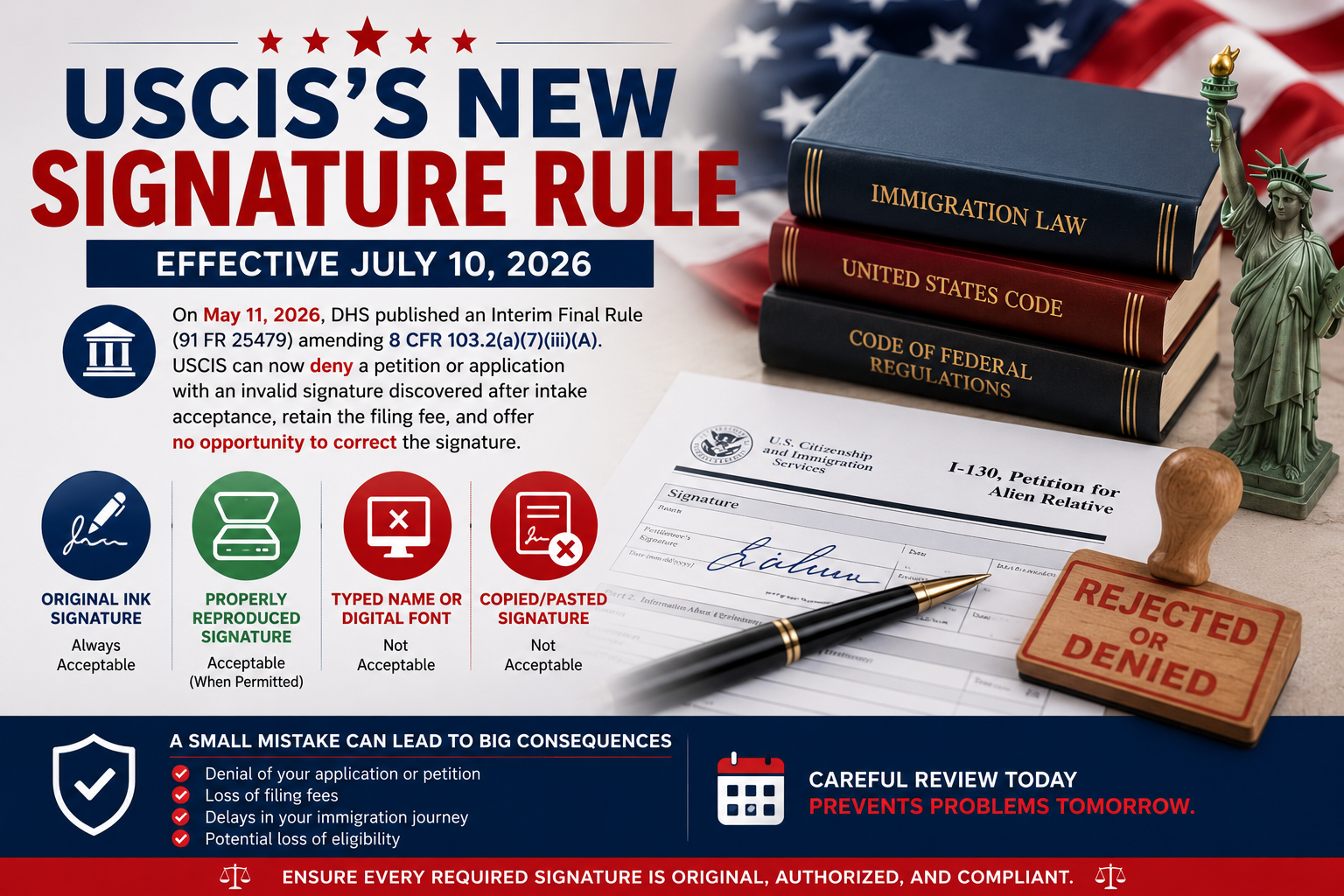
On May 11, 2026, the Department of Homeland Security published an Interim Final Rule in the Federal Register amending 8 C.F.R. § 103.2(a)(7)(ii)(A). Effective July 10, 2026, the rule expressly authorizes U.S. Citizenship and Immigration Services (USCIS) to deny an application or petition if it later discovers that the filing contains an invalid signature—even after the case has been accepted and a receipt notice has been issued. In such circumstances, USCIS may retain the filing fee and is not required to allow the applicant to correct the signature on the pending filing.
Although this change relates to a procedural requirement, its practical impact can be significant. A simple signature error could result in the loss of filing fees, substantial processing delays, or even the loss of eligibility for certain immigration benefits where filing deadlines are critical.
What Changed?
The Interim Final Rule amends 8 C.F.R. § 103.2(a)(7)(ii)(A) and clarifies USCIS’s authority when a filing contains an invalid signature.
Prior to this amendment, USCIS’s handling of improperly signed filings was not always uniform. In some cases, applications were rejected and filing fees were returned. In others, petitions were denied after acceptance, with the filing fee retained. Because the governing regulation did not expressly address every situation, the outcome often depended on when and how the signature defect was discovered.
The new regulation eliminates much of that uncertainty by expressly providing USCIS with the authority to either reject or deny a benefit request if an invalid signature is identified after intake acceptance. The rule applies to all immigration benefit requests submitted on or after July 10, 2026.
Why Is This Important?
Many applicants assume that once USCIS accepts a filing and issues a receipt notice, the application has cleared the initial procedural review.
Under the new regulation, that assumption may no longer be safe.
If USCIS later determines that the required signature does not satisfy its regulatory requirements, the agency may deny the application without first providing an opportunity to cure the defect. In addition, USCIS may retain the filing fee even though the application is denied on procedural grounds.
For applicants filing close to statutory or regulatory deadlines, the consequences can be particularly severe.
What Is Considered a Valid Signature?
USCIS continues to recognize two primary forms of signatures:
Original Handwritten Signatures
The safest method remains an original handwritten signature made personally by the individual required to sign the form.
Properly Reproduced Signatures
Where USCIS permits reproduced signatures, a scanned, photocopied, or faxed reproduction of an original handwritten signature remains acceptable, provided it accurately reproduces the signer’s original ink signature.
Applicants and petitioners should remember that USCIS may request the original signed document at any time, and the original should therefore be retained.
What May Be Considered an Invalid Signature?
While every case depends on its facts, examples of problematic signatures may include:
- Typing a person’s name into the signature block.
- Using a computer-generated script or cursive font that merely resembles handwriting.
- Affixing a signature that was not personally authorized by the required signer.
- Using an electronic signature method that is not permitted under USCIS regulations for the particular filing.
- Omitting a required signature altogether.
Even if the application is initially accepted for processing, discovery of an invalid signature later in the adjudication process may now result in denial.
Employers Should Review Their Internal Filing Procedures
The new rule is particularly important for employers that regularly file immigration petitions, including:
- H-1B petitions
- L-1 petitions
- O-1 petitions
- PERM-related filings
- Employment-based immigrant petitions
Many employers rely on electronic document management systems or obtain signatures remotely from executives located in different states or countries.
Human resources departments and in-house legal teams should review their existing procedures to ensure that every USCIS filing complies with the new signature requirements before submission.
Practical Tips to Avoid Signature Problems
Although the rule is strict, avoiding problems is relatively straightforward with careful preparation.
Before filing an immigration benefit request:
- Review every signature page before submission.
- Confirm that every required individual has signed the appropriate section.
- Ensure that reproduced signatures originate from an actual handwritten signature where permitted.
- Avoid relying on typed names or stylized digital fonts unless specifically authorized by USCIS.
- Retain the original signed documents in your records in case USCIS later requests them.
A careful final review may prevent months of delay and the unnecessary expense of refiling.
Immigration Compliance Is Becoming Increasingly Technical
This signature rule reflects a broader trend within immigration practice. Recent regulatory and policy changes demonstrate that USCIS is placing greater emphasis on strict compliance with procedural requirements.
Many filing errors that were once viewed as curable technical defects may now carry much greater consequences.
For that reason, immigration filings increasingly require careful attention not only to eligibility requirements but also to procedural compliance, documentation, timing, and presentation.
Final Thoughts
The new signature regulation may appear to address only a technical aspect of the filing process, but its consequences can be substantial.
Beginning July 10, 2026, applicants, employers, and attorneys should treat signature requirements with the same level of care as any other statutory or regulatory filing requirement. Ensuring that forms are properly executed before submission may help avoid unnecessary denials, additional filing fees, and significant delays in the immigration process.
If you are uncertain whether your application complies with the new signature requirements or have questions about your immigration filing, consulting with an experienced immigration attorney before submission can help identify and correct potential issues before they become costly problems.
References
- Interim Final Rule: Department of Homeland Security, U.S. Citizenship and Immigration Services, Benefit Request Signature Requirements, 91 Fed. Reg. 25479 (May 11, 2026).
- Regulation: 8 C.F.R. § 103.2(a)(7)(ii)(A) (effective July 10, 2026).