
EB-1A Extraordinary Ability Green Card: What It Is, Who Qualifies, and Common Misconceptions

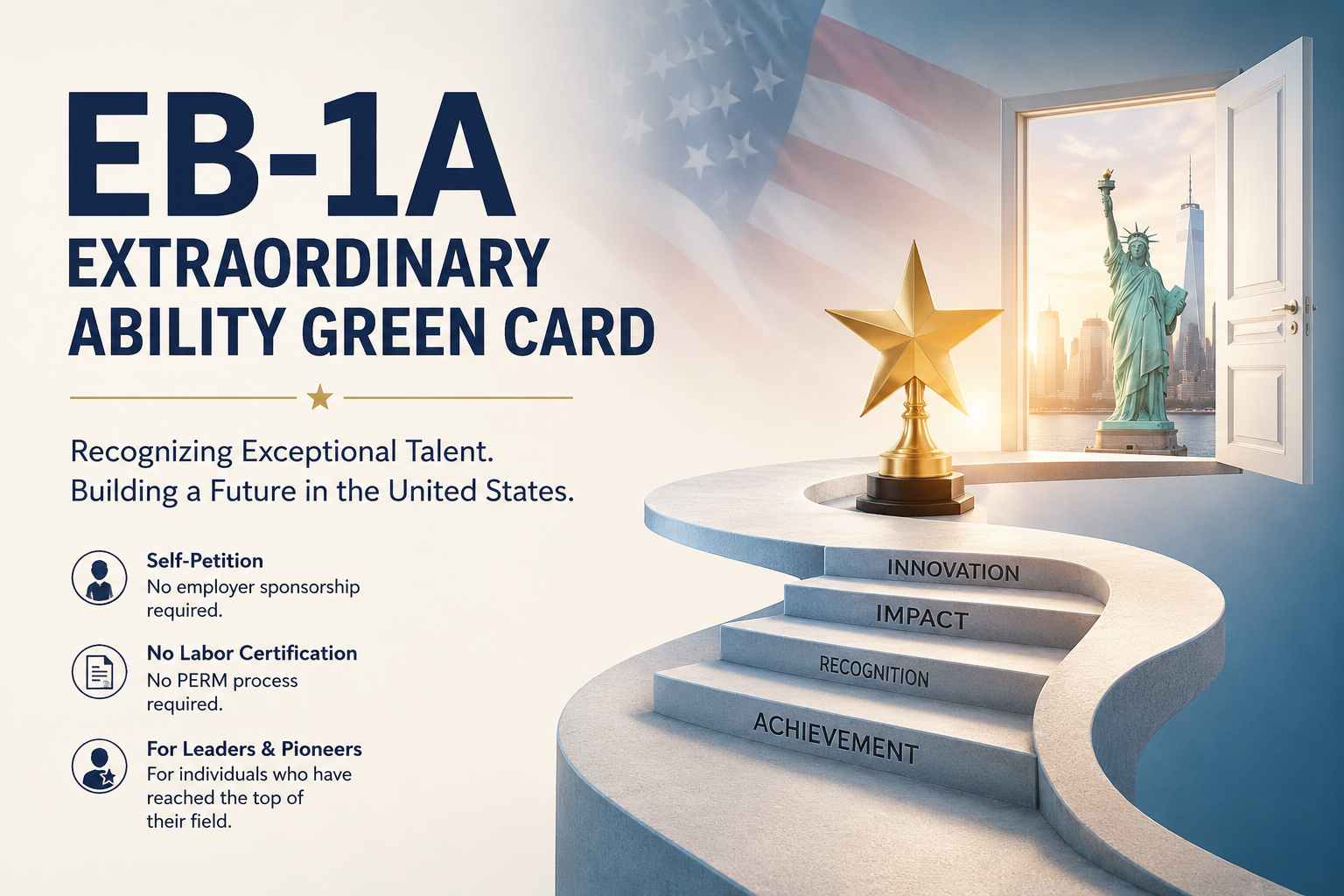
The EB-1A Extraordinary Ability Green Card is one of the most prestigious employment-based immigration categories in U.S. immigration law. It is also one of the most misunderstood.
Many people believe the EB-1A category is reserved exclusively for Nobel Prize winners, Olympic athletes, movie stars, or world-famous scientists. While recipients of internationally recognized awards may certainly qualify, the law is much broader than many people realize.
Engineers, researchers, physicians, entrepreneurs, professors, artists, business executives, software professionals, inventors, and individuals in many other professions may qualify if they can demonstrate extraordinary ability through the evidence recognized under U.S. immigration law.
This article explains what the EB-1A category is, who may qualify, and dispels several common misconceptions.
What Is the EB-1A Extraordinary Ability Green Card?
The EB-1A category allows individuals with extraordinary ability in the sciences, arts, education, business, or athletics to obtain permanent residence in the United States.
Unlike many employment-based immigration categories, an EB-1A applicant generally:
- Does not need a permanent job offer.
- Does not need a labor certification (PERM).
- May self-petition, meaning no employer sponsorship is required.
These features make the EB-1A category particularly attractive for highly accomplished professionals who wish to pursue their careers independently or whose work spans multiple employers, institutions, or projects.
What Does “Extraordinary Ability” Mean?
The term “extraordinary ability” often causes unnecessary concern.
It does not mean that an applicant must be the single best person in the world in a particular profession.
Instead, the law requires evidence that the individual has risen to a level of expertise indicating that they are among the small percentage who have reached the very top of their field of endeavor.
USCIS evaluates each case based on the totality of the evidence submitted. There is no single checklist that guarantees approval, nor is there one accomplishment that automatically disqualifies an applicant.
Who Can Qualify?
The EB-1A category is available to individuals working in many different professions.
Examples include:
- Scientists
- Researchers
- Physicians
- Engineers
- Software developers
- Artificial Intelligence professionals
- University professors
- Entrepreneurs
- Business executives
- Inventors
- Architects
- Artists
- Musicians
- Athletes
- Educators
The profession itself is not what determines eligibility. Instead, USCIS evaluates the applicant’s achievements within that profession.
Common Misconception #1: “I Need a Nobel Prize”
One of the biggest myths surrounding EB-1A is that only Nobel Prize winners qualify.
While receiving a major internationally recognized award is one method of establishing eligibility, very few applicants qualify under that route.
Instead, most successful petitions are evaluated under a separate framework that considers various forms of professional achievement.
We will discuss this framework in detail in a later article in this series.
Common Misconception #2: “My Employer Must Sponsor Me”
Unlike many employment-based green card categories, EB-1A generally allows applicants to file the petition on their own behalf.
This means that changing employers, working for multiple organizations, consulting independently, or even starting a business does not necessarily prevent an individual from pursuing an EB-1A petition.
Common Misconception #3: “Only Academics Can Qualify”
Although many university professors and researchers pursue EB-1A classification, the category is not limited to academia.
Professionals working in private industry frequently qualify.
For example, experienced engineers, software professionals, physicians, entrepreneurs, and business leaders may qualify depending upon their accomplishments and supporting evidence.
Common Misconception #4: “A High Salary Alone Is Enough”
Receiving a high salary may be relevant evidence in certain cases.
However, a high income alone does not establish eligibility.
Likewise, receiving patents, publishing research papers, speaking at conferences, judging competitions, or managing important projects does not automatically qualify someone for EB-1A.
USCIS evaluates all of the evidence together before determining whether the legal standard has been met.
Every EB-1A Case Is Different
No two EB-1A cases are alike.
One applicant may have an extensive publication record.
Another may have developed widely used technology.
A third applicant may have demonstrated extraordinary achievements through business leadership or innovation.
Because careers develop differently, the strongest evidence varies from one individual to another.
A successful petition often depends on identifying the applicant’s strongest accomplishments and presenting them within the legal framework established by USCIS.
Should You Consider an EB-1A Petition?
If you have consistently distinguished yourself within your profession and have received significant recognition for your work, it may be worthwhile to evaluate whether you qualify for EB-1A.
Many individuals assume they are not eligible simply because they do not have international fame. Others assume they qualify based on a single accomplishment.
Both assumptions can be incorrect.
An experienced immigration attorney can evaluate your professional accomplishments, identify the strongest evidence supporting your case, and determine whether the EB-1A category may be appropriate.
Coming Next in This Series
In the next article, we will explain how USCIS actually analyzes an EB-1A petition, including the three-step framework used by immigration officers to determine whether an applicant qualifies for this prestigious immigration category.
Disclaimer
This article is provided for general informational purposes only and does not constitute legal advice. Every immigration case is unique. Reading this article does not create an attorney-client relationship. If you would like an evaluation of your qualifications for an EB-1A petition, you should consult with a qualified immigration attorney.