
EB-1A Extraordinary Ability: Understanding the First Five Regulatory Criteria

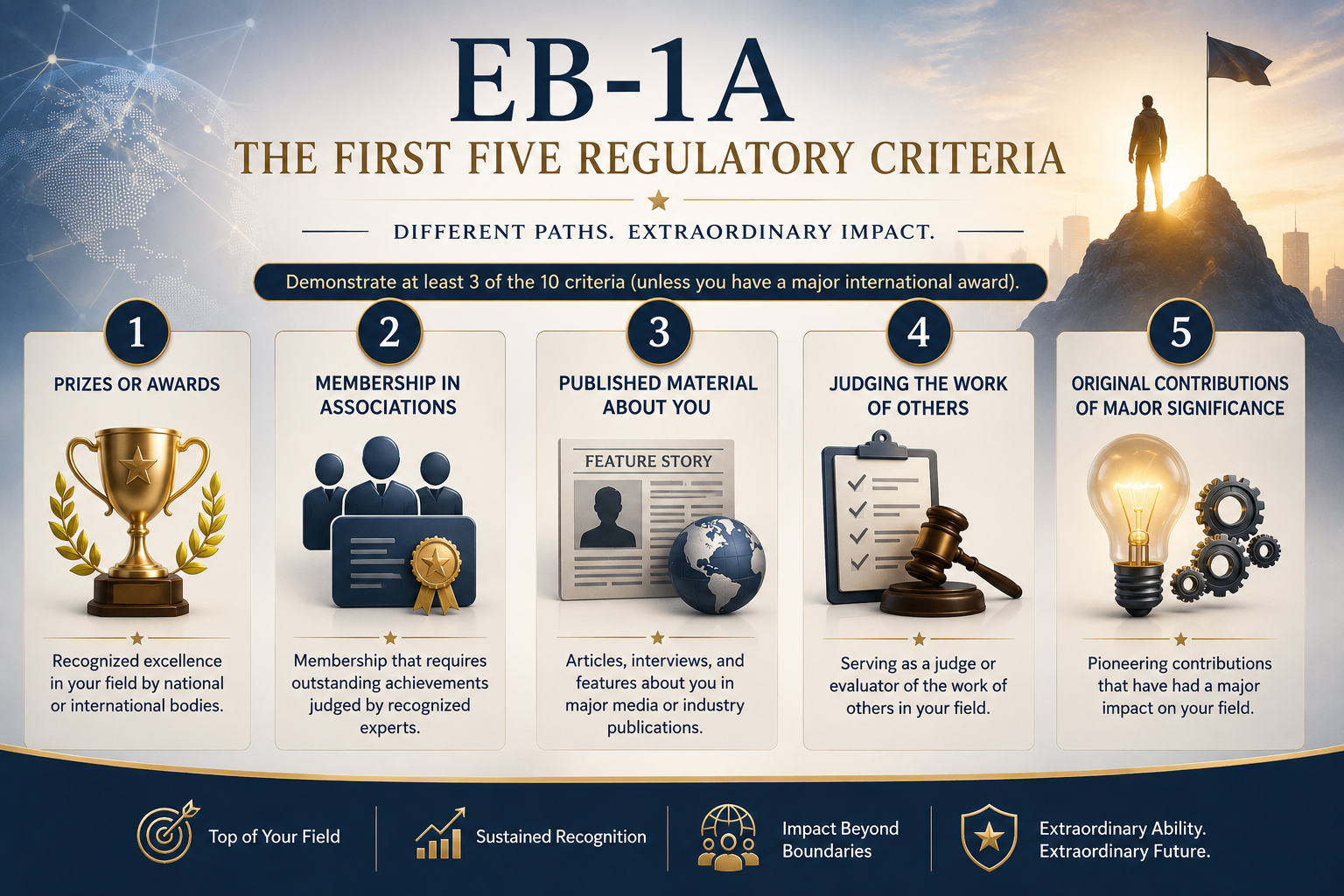
In our previous article, we discussed the three-step framework USCIS uses to evaluate an EB-1A petition. One of those steps requires applicants to demonstrate that they satisfy at least three of the regulatory criteria unless they have received a qualifying one-time internationally recognized award.
In this article, we examine the first five regulatory criteria and discuss the types of evidence USCIS commonly evaluates.
It is important to remember that satisfying a regulatory criterion does not automatically establish eligibility for EB-1A. USCIS first determines whether the criterion has been met and then considers all of the evidence during the final merits determination discussed in our previous article.
Criterion 1 – Lesser Nationally or Internationally Recognized Prizes or Awards
USCIS considers whether the applicant has received nationally or internationally recognized prizes or awards for excellence in the field.
The focus is not simply whether an award exists, but whether it recognizes excellence and carries meaningful recognition beyond the applicant’s immediate employer or organization.
Examples may include:
- National professional awards
- International industry awards
- Research awards
- Innovation awards
- Distinguished teaching awards
- Engineering excellence awards
Generally, certificates of participation, attendance awards, or internal employee recognition programs carry significantly less evidentiary value unless accompanied by evidence demonstrating broader professional significance.
Criterion 2 – Membership in Associations That Require Outstanding Achievements
This criterion is frequently misunderstood.
Merely belonging to a professional organization is usually insufficient.
Instead, USCIS examines whether membership itself requires outstanding achievements judged by recognized experts.
Examples that may satisfy this criterion include professional societies that admit members only after a rigorous evaluation of significant professional accomplishments.
Organizations that permit membership simply by paying dues or meeting minimum educational requirements generally do not satisfy this criterion.
Criterion 3 – Published Material About the Applicant
This criterion focuses on published material discussing the applicant or the applicant’s work.
Examples may include:
- Newspaper articles
- Professional magazines
- Industry publications
- Trade journals
- Online publications with established editorial standards
Importantly, this criterion concerns material about the applicant rather than material written by the applicant.
For example, an article profiling an engineer’s innovative work may satisfy this criterion, whereas a technical paper authored by the engineer is generally evaluated under the scholarly publications criterion.
Criterion 4 – Participation as a Judge of the Work of Others
USCIS considers whether the applicant has served as a judge of the work of others within the same or an allied field.
Examples include:
- Peer review of scholarly manuscripts
- Reviewing conference submissions
- Judging innovation competitions
- Serving on doctoral dissertation committees
- Evaluating grant applications
- Judging professional competitions
The applicant should demonstrate both the nature of the judging activity and why they were selected to perform that role.
Criterion 5 – Original Contributions of Major Significance
This is often one of the most important—and most challenging—criteria.
USCIS does not simply ask whether the applicant made an original contribution.
Instead, the agency evaluates whether the contribution is of major significance within the field.
Examples may include:
- Development of widely adopted technology
- Significant medical innovations
- Influential software architecture
- Novel engineering solutions
- Scientific discoveries
- Industry-changing business methodologies
Evidence frequently includes:
- Independent expert recommendation letters
- Citation evidence
- Patent licensing
- Adoption by industry
- Commercial implementation
- Media coverage
- Independent recognition
Merely obtaining a patent does not automatically establish this criterion. Likewise, developing an innovative product is only part of the analysis. The applicant should demonstrate how the contribution influenced the broader field.
Because this criterion is frequently misunderstood, we will devote an entire article to it later in this series.
Frequently Asked Questions
Do I need to satisfy all five criteria?
No.
Most applicants qualify by satisfying at least three of the ten regulatory criteria before USCIS proceeds to the final merits determination.
Is one criterion more important than another?
Not necessarily.
Some criteria naturally carry greater persuasive value depending upon the applicant’s profession, while others may be less applicable.
The strongest petitions focus on the applicant’s genuine accomplishments rather than attempting to force evidence into every criterion.
Should I submit every piece of evidence I have?
Not always.
Quality is generally more persuasive than quantity.
Well-organized evidence demonstrating meaningful professional distinction is often more effective than submitting hundreds of pages of marginally relevant documents.
Coming Next
In the next article, we will examine the remaining five regulatory criteria, including scholarly publications, leading or critical roles, high salary, artistic exhibitions, and commercial success in the performing arts.
Disclaimer
This article is intended for general informational purposes only and does not constitute legal advice. Every immigration case is unique. Consultation with a qualified immigration attorney is recommended before filing any immigration petition.