
EB-1A Extraordinary Ability: Understanding the Remaining Five Regulatory Criteria

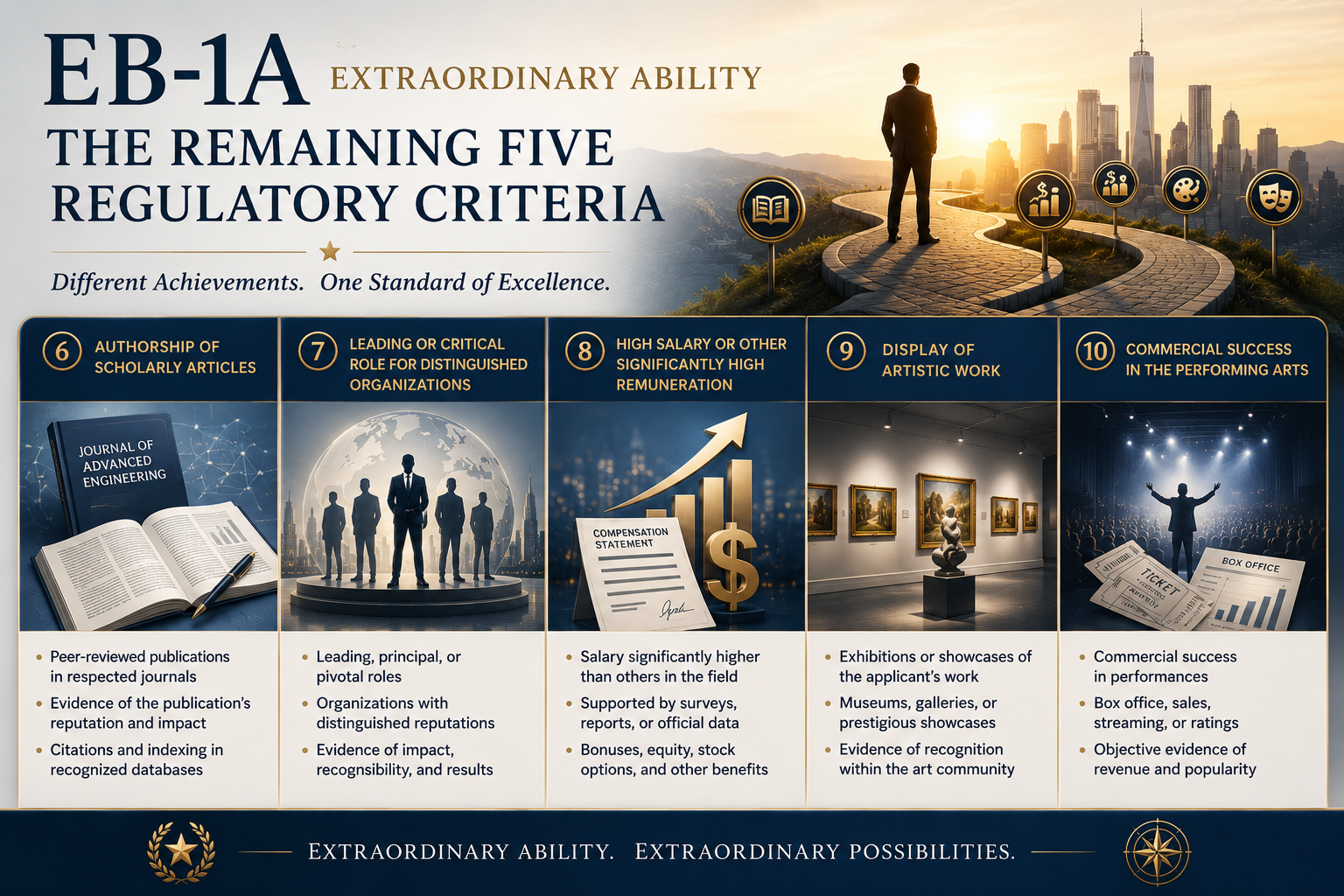
In our previous article, we discussed the first five regulatory criteria used by USCIS when evaluating an EB-1A Extraordinary Ability petition. In this article, we examine the remaining five criteria and discuss the types of evidence that applicants commonly submit to establish eligibility.
As with the first five criteria, satisfying one or more of these criteria does not automatically guarantee approval. USCIS first evaluates whether each criterion has been met and then considers all of the evidence during the final merits determination.
Criterion 6 – Authorship of Scholarly Articles
USCIS considers whether the applicant has authored scholarly articles in professional or major trade publications or other major media.
For many researchers, scientists, physicians, and university professors, this criterion is commonly satisfied through peer-reviewed publications.
However, scholarly articles are not limited to academia. Depending upon the field, technical publications in respected industry journals may also be relevant.
Evidence often includes:
- Copies of published articles
- Journal information
- Evidence regarding the publication’s reputation
- Citation history
- Indexing in recognized research databases
Simply publishing an article is not always sufficient. USCIS may consider the nature of the publication and its significance within the profession.
Criterion 7 – Leading or Critical Role for Distinguished Organizations
This criterion evaluates whether the applicant has performed in a leading or critical role for organizations or establishments with distinguished reputations.
There are two separate components:
- Was the organization distinguished?
- Was the applicant’s role leading or critical?
Examples may include:
- Technical leadership for Fortune 500 companies
- Principal engineers responsible for major products
- Medical directors
- Chief scientists
- Startup founders leading highly recognized companies
- Executive leadership within respected organizations
Applicants should demonstrate not only their job title but also the importance of their responsibilities and the impact of their work on the organization.
Criterion 8 – High Salary or Other Significantly High Remuneration
Many applicants assume that a high salary automatically satisfies this criterion.
In reality, USCIS compares the applicant’s compensation against others working in the same field.
Relevant evidence may include:
- Salary surveys
- Bureau of Labor Statistics data
- Industry compensation reports
- Stock options
- Bonuses
- Equity compensation
- Total compensation packages
For example, a software engineer earning compensation significantly above others with similar experience in the same geographic market may present stronger evidence than salary alone would suggest.
Likewise, entrepreneurs may demonstrate remuneration through equity interests, distributions, or other forms of compensation depending upon the circumstances.
Criterion 9 – Display of Artistic Work
This criterion primarily applies to artists.
USCIS considers whether the applicant’s work has been displayed at artistic exhibitions or showcases.
Examples may include:
- Museum exhibitions
- Gallery shows
- International art fairs
- Curated exhibitions
- Prestigious design showcases
This criterion generally has limited application outside artistic professions.
Criterion 10 – Commercial Success in the Performing Arts
This criterion applies primarily to individuals working in the performing arts.
Commercial success may be demonstrated through evidence such as:
- Box office receipts
- Music sales
- Streaming statistics
- Television ratings
- Revenue generated from performances
- Other objective evidence demonstrating commercial success
Like the artistic exhibition criterion, this criterion is profession-specific and is not expected to apply in most engineering, scientific, or business cases.
Not Every Criterion Applies to Every Profession
One of the most common misconceptions about EB-1A is that applicants should attempt to satisfy every regulatory criterion.
That is not how the regulations work.
An engineer is unlikely to demonstrate artistic exhibitions.
A professional musician is unlikely to establish scholarly publications.
A physician may never have participated in a museum exhibition.
USCIS recognizes that extraordinary ability may be demonstrated differently depending upon the applicant’s profession.
Successful petitions focus on the criteria that genuinely reflect the applicant’s accomplishments rather than forcing evidence into categories that do not naturally apply.
Focus on Your Strongest Evidence
Applicants often ask,
“Which criteria should I pursue?”
The better question is:
“Which criteria best tell the story of my professional accomplishments?”
The strongest EB-1A petitions are built around authentic achievements.
Attempting to satisfy a criterion with weak or marginal evidence can sometimes detract from the overall presentation.
Instead, applicants should identify the criteria that naturally align with their careers and present compelling evidence supporting those accomplishments.
Bringing the Criteria Together
At this point in our series, you have been introduced to all ten regulatory criteria.
Remember, these criteria represent only one part of the EB-1A analysis.
Ultimately, USCIS evaluates the evidence as a whole to determine whether the applicant has demonstrated sustained national or international acclaim and has risen to the very top of the field of endeavor.
The objective is not merely to satisfy three criteria—it is to present a persuasive picture of extraordinary ability.
Coming Next
In our next article, we will take a closer look at one of the most important—and most frequently litigated—EB-1A criteria:
Original Contributions of Major Significance.
We will discuss what USCIS means by “major significance,” the types of evidence that strengthen this criterion, and common mistakes applicants should avoid.
Disclaimer
This article is provided for general informational purposes only and does not constitute legal advice. Every immigration case is unique. Reading this article does not create an attorney-client relationship. If you believe you may qualify for an EB-1A petition, you should consult with a qualified immigration attorney.