
EB-1A Original Contributions of Major Significance: What USCIS Really Looks For

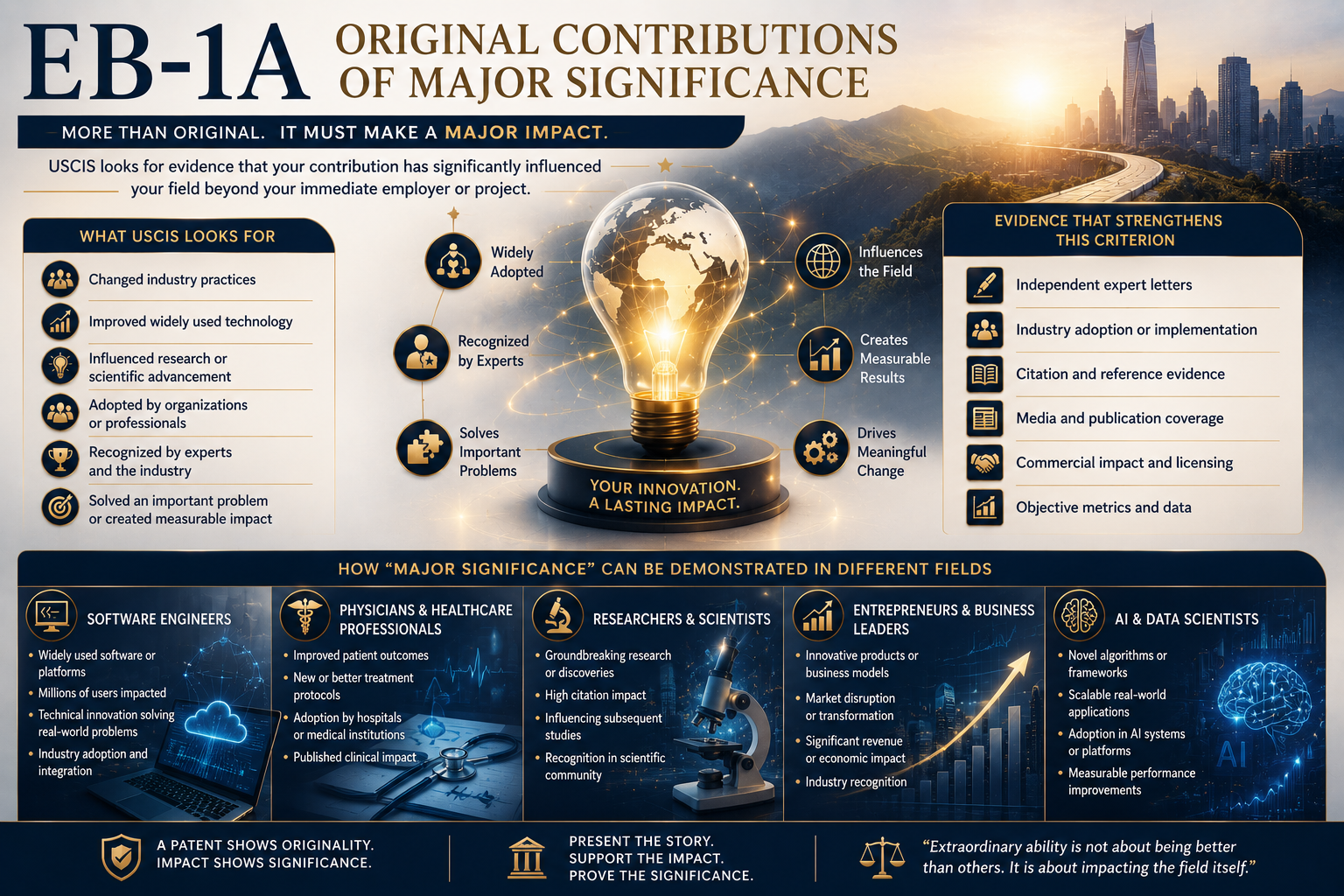
Among the ten regulatory criteria used to evaluate an EB-1A Extraordinary Ability petition, few generate more questions than Original Contributions of Major Significance.
Applicants often assume that obtaining a patent, developing a new product, publishing research, or inventing a new process automatically satisfies this criterion.
Unfortunately, that is not how USCIS evaluates these cases.
The regulation requires more than originality. It requires evidence that the applicant’s contribution is of major significance in the field.
Understanding the difference is essential when preparing a successful EB-1A petition.
Original Does Not Automatically Mean Significant
Many talented professionals create original work every day.
Researchers develop new methodologies.
Software engineers write original code.
Physicians introduce improved treatment protocols.
Business leaders design innovative operational strategies.
These accomplishments may all be original.
However, USCIS asks an additional question:
Did the contribution meaningfully influence the field?
That is the distinction that separates this criterion from ordinary professional achievement.
What Does “Major Significance” Mean?
The immigration regulations do not define the phrase “major significance.”
Instead, USCIS evaluates the evidence to determine whether the applicant’s contribution has had a meaningful impact beyond his or her immediate employer or project.
Examples might include contributions that:
- Changed industry practices.
- Improved widely used technology.
- Influenced scientific research.
- Were adopted by numerous organizations.
- Solved an important technical problem.
- Advanced medical treatment.
- Significantly improved business operations.
- Led to measurable industry recognition.
The emphasis is not simply on creating something new.
The emphasis is on demonstrating impact.
A Patent Alone Is Usually Not Enough
One of the most common misconceptions involves patents.
Many applicants believe:
“I have several patents, therefore I satisfy this criterion.”
Not necessarily.
A patent demonstrates originality.
It does not, by itself, establish that the invention became important within the profession.
USCIS may instead consider questions such as:
- Was the invention adopted?
- Was it licensed?
- Did it generate revenue?
- Did competitors rely upon it?
- Was it cited by others?
- Did experts recognize its importance?
- Did it change how others perform their work?
The same analysis applies to software, engineering innovations, research discoveries, and business methodologies.
Evidence That Strengthens This Criterion
Strong petitions typically combine multiple forms of evidence.
Examples include:
Independent Expert Letters
Independent experts explaining why the contribution matters often provide important context.
The most persuasive letters explain:
- the problem that existed,
- the applicant’s solution,
- and the measurable impact on the field.
Industry Adoption
Evidence that others have adopted the applicant’s work can be persuasive.
Examples include:
- licensing agreements,
- implementation by customers,
- use by hospitals,
- deployment by government agencies,
- adoption by industry partners.
Citation Evidence
Researchers frequently rely upon citation evidence.
If other scholars build upon the applicant’s work, that may demonstrate influence within the field.
However, citation numbers should always be evaluated in context.
Citation practices vary considerably between disciplines.
Media Recognition
Industry publications discussing the innovation can demonstrate that the contribution received recognition beyond the applicant’s employer.
Commercial Impact
Commercial success alone is not enough.
However, if an innovation produced measurable economic benefits because of its technical significance, that evidence may strengthen the overall presentation.
Objective Metrics
Whenever possible, objective evidence is preferable.
Examples include:
- cost savings,
- performance improvements,
- efficiency gains,
- increased reliability,
- user adoption,
- revenue generation,
- improved patient outcomes,
- reduced manufacturing costs.
Numbers often tell a persuasive story.
Different Professions Demonstrate Impact Differently
No single type of evidence applies to every profession.
An engineer may demonstrate impact through widely adopted technology.
A physician may demonstrate improved patient outcomes.
A scientist may rely upon citations and subsequent research.
An entrepreneur may demonstrate widespread commercial adoption.
A software engineer may show that millions of users benefit from a platform incorporating the applicant’s innovation.
USCIS evaluates each case within the context of the applicant’s profession.
Recommendation Letters Should Explain Why the Contribution Matters
Many recommendation letters make the same mistake.
They simply state:
“The applicant is outstanding.”
That conclusion is rarely enough.
A stronger letter explains:
- What problem existed?
- What did the applicant create?
- Why was it different?
- Who benefited?
- How has the profession changed because of it?
- Why is it important beyond the employer?
Specific examples are generally more persuasive than broad praise.
Common Mistakes
Applicants sometimes weaken this criterion by relying exclusively on:
- The existence of patents.
- Job responsibilities.
- Internal praise from supervisors.
- Performance evaluations.
- Self-authored descriptions of accomplishments.
While these materials may be relevant, they are generally stronger when accompanied by independent evidence demonstrating broader professional significance.
Tell the Story of the Contribution
Rather than presenting documents without explanation, applicants should help USCIS understand the narrative behind the innovation.
A successful presentation often answers four questions:
- What problem existed?
- What did the applicant contribute?
- Why was it innovative?
- What measurable impact did it have on the profession?
When those questions are answered clearly and supported by objective evidence, USCIS is better positioned to understand why the contribution is of major significance.
Coming Next
In our next article, we will discuss another frequently misunderstood EB-1A criterion:
Leading or Critical Role for Distinguished Organizations.
We will examine what USCIS means by “leading” and “critical,” how distinguished organizations are evaluated, and the types of evidence that commonly support this criterion.
Disclaimer
This article is intended for general informational purposes only and does not constitute legal advice. Every immigration case is unique. Consultation with a qualified immigration attorney is recommended before filing any immigration petition.