
How USCIS Evaluates an EB-1A Petition: Understanding the Three-Step Analysis

In our first article, we explained what the EB-1A Extraordinary Ability Green Card is and discussed some of the common misconceptions surrounding this immigration category.
The next question most prospective applicants ask is:
“How does USCIS decide whether I qualify?”
Many people believe that satisfying a certain number of regulatory criteria automatically guarantees approval. Others assume that possessing an impressive résumé is sufficient.
Neither assumption is correct.
USCIS evaluates every EB-1A petition using a structured legal framework. Understanding that framework is essential because it helps applicants focus on the evidence that truly matters.
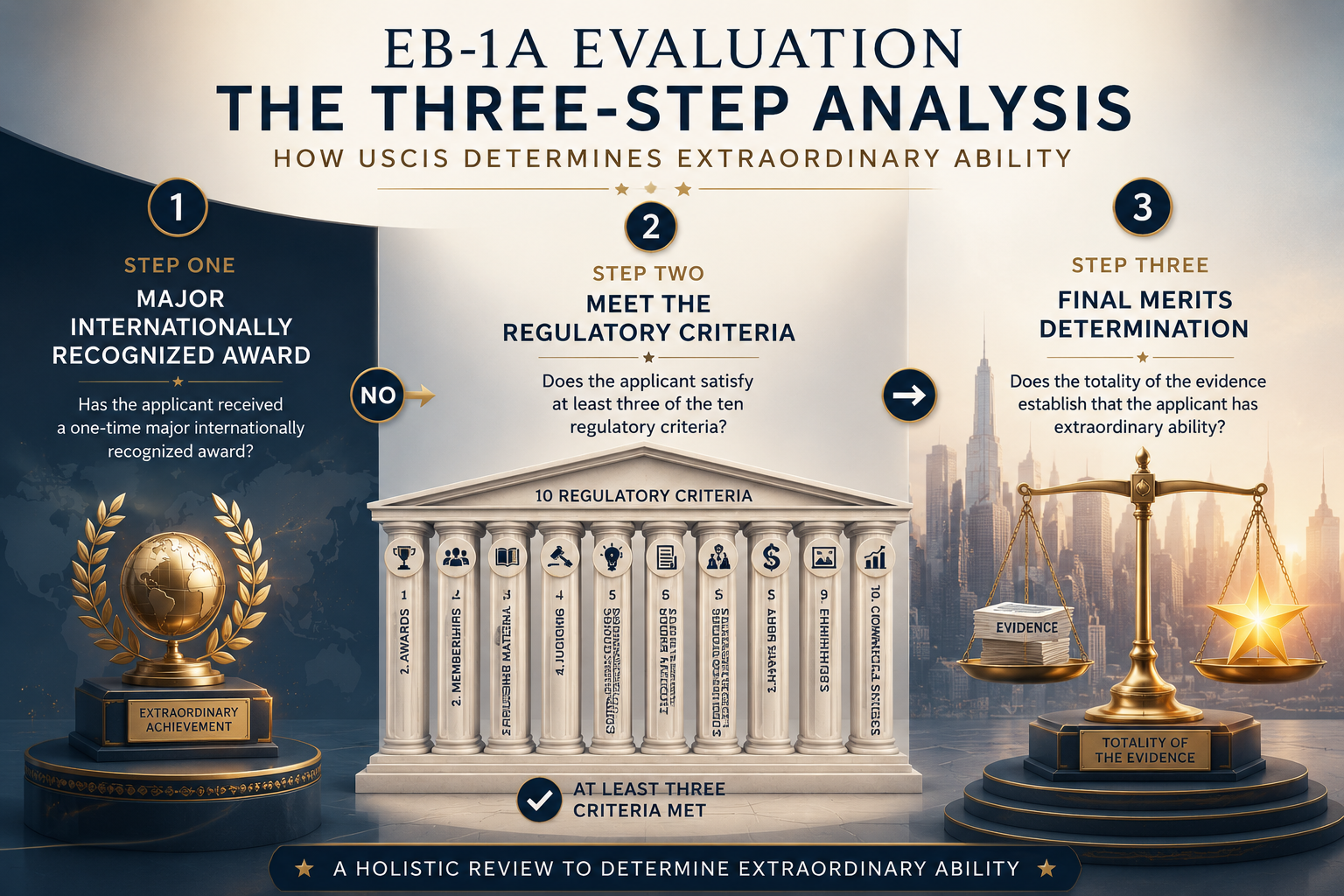
Step One: Has the Applicant Won a Major Internationally Recognized Award?
The first question USCIS asks is straightforward.
Has the applicant received a one-time, major internationally recognized award?
Examples might include internationally recognized awards that demonstrate extraordinary achievement within a particular field.
Very few applicants qualify under this route.
Accordingly, most EB-1A petitions proceed to the second step of the analysis.
Step Two: Does the Applicant Meet the Regulatory Criteria?
If the applicant has not received a qualifying one-time major internationally recognized award, USCIS evaluates the evidence under the regulatory criteria.
Generally, the applicant must demonstrate that they satisfy at least three of the regulatory criteria established under the immigration regulations.
These criteria evaluate different forms of professional achievement, including such accomplishments as nationally or internationally recognized awards, published material about the applicant, participation as a judge of the work of others, original contributions, scholarly publications, leading or critical roles, high salary, and other forms of recognized achievement.
Each criterion has its own legal standard and evidentiary requirements.
Importantly, simply claiming to satisfy three criteria is not enough. USCIS carefully reviews whether the evidence actually establishes that each criterion has been met.
In future articles, we will examine each of these criteria individually and discuss the types of evidence that USCIS commonly evaluates.
Step Three: The Final Merits Determination
Many applicants are surprised to learn that satisfying three regulatory criteria does not automatically result in approval.
Once USCIS determines that the applicant has established the required threshold criteria, the officer proceeds to what is commonly referred to as the final merits determination.
During this stage, USCIS evaluates the evidence as a whole to determine whether it demonstrates that the applicant has reached the level of extraordinary ability required by law.
In other words, USCIS asks whether the totality of the evidence establishes that the applicant is among the small percentage who have risen to the very top of their field of endeavor.
This holistic review is one of the most important aspects of an EB-1A petition.
An applicant may satisfy three regulatory criteria but still fail to persuade USCIS that the overall evidence demonstrates extraordinary ability.
Conversely, a carefully prepared petition that presents compelling evidence within the broader context of the applicant’s career may present a much stronger case.
Why the Final Merits Determination Matters
Many applicants understandably focus on checking boxes.
However, experienced immigration attorneys often spend just as much time explaining why the evidence matters as they do gathering the evidence itself.
For example:
- A patent is not automatically evidence of extraordinary ability simply because it exists.
- Publishing research does not automatically establish extraordinary ability.
- Holding a managerial position does not automatically satisfy the leading or critical role criterion.
Instead, USCIS evaluates the significance of those accomplishments within the applicant’s profession.
The objective is not simply to prove that the applicant has had a successful career.
Rather, the evidence should demonstrate that the applicant has achieved sustained national or international acclaim and has risen to the top of the field.
Think of the Process Like Building a House
One helpful analogy is to think of the EB-1A analysis as building a house.
The regulatory criteria provide the foundation.
Without a sufficient foundation, the petition cannot succeed.
However, the foundation alone is not the finished house.
The final merits determination represents the completed structure.
USCIS steps back and evaluates whether everything presented together demonstrates extraordinary ability.
For this reason, successful EB-1A petitions are not simply collections of documents.
They are carefully organized presentations that explain how each accomplishment contributes to the applicant’s overall professional distinction.
Every Piece of Evidence Should Tell a Story
Rather than asking,
“How do I satisfy three criteria?”
a better question is:
“How does each piece of evidence demonstrate that I have achieved sustained acclaim within my profession?”
That shift in perspective often leads to a stronger petition.
The most persuasive cases present a consistent narrative demonstrating professional excellence, influence within the field, and recognition by others.
Coming Next
In our next article, we will begin examining each of the ten regulatory criteria in detail, including the evidence USCIS commonly evaluates and some of the most frequent mistakes applicants make.
Disclaimer
This article is provided for general informational purposes only and does not constitute legal advice. Every immigration case is unique. Reading this article does not create an attorney-client relationship. If you believe you may qualify for an EB-1A petition, you should consult with a qualified immigration attorney.