
Should You Apply for a B-1/B-2 Visitor Visa Extension? Understanding the Benefits, Risks, and Alternatives

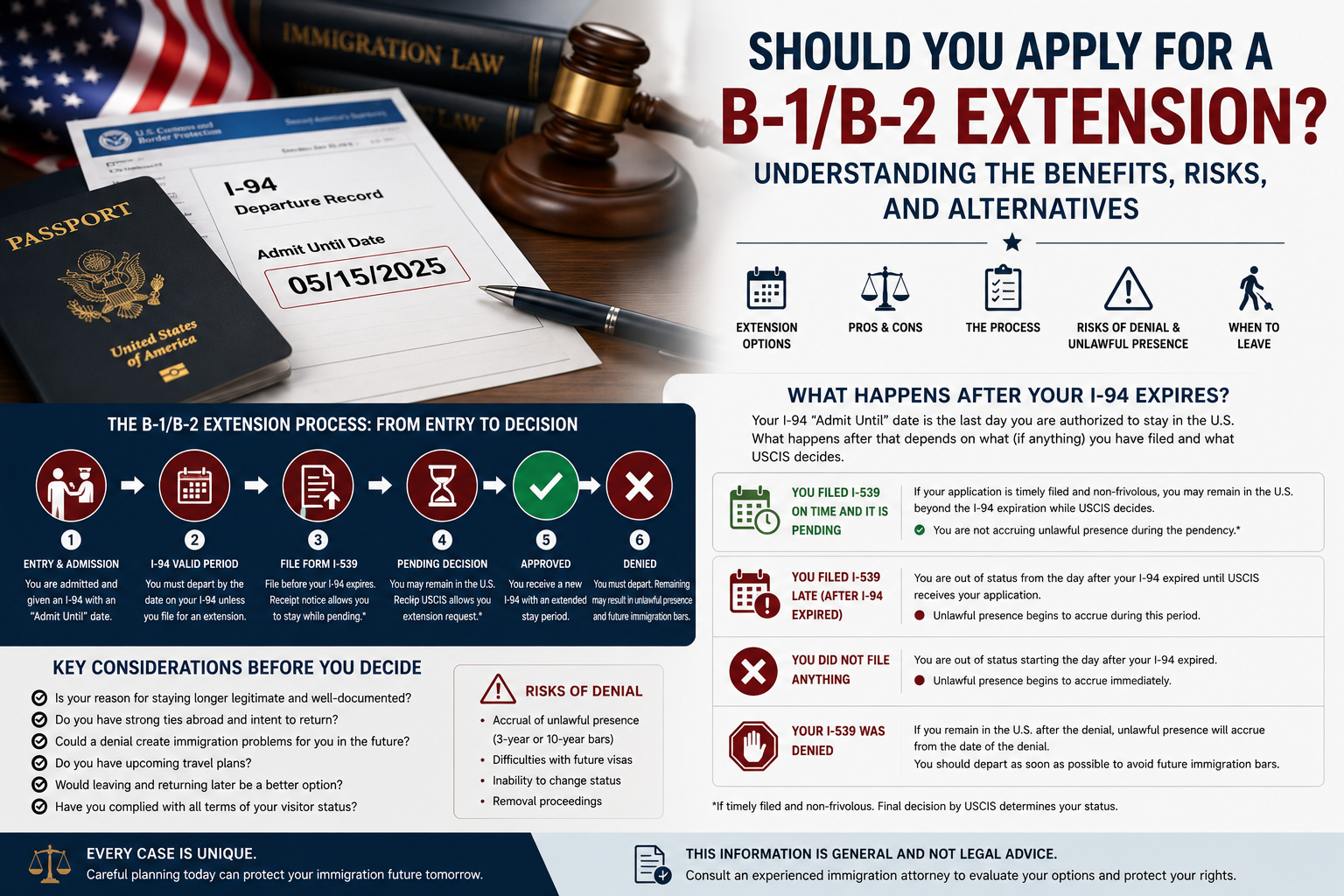
Many visitors to the United States find themselves needing additional time beyond the period originally granted by U.S. Customs and Border Protection (CBP). A family emergency may arise, medical treatment may take longer than expected, or unforeseen events may require a temporary change in travel plans.
In appropriate circumstances, U.S. Citizenship and Immigration Services (USCIS) permits visitors to request an extension of stay by filing Form I-539, Application to Extend/Change Nonimmigrant Status.
However, filing an extension is not always the best option.
Although an extension may be appropriate in some cases, it also carries important legal and practical considerations. A request may remain pending for many months, may ultimately be denied, and could affect future travel or visa applications depending on the circumstances.
Before filing Form I-539, visitors should understand not only the filing requirements, but also the potential immigration consequences of both approval and denial.
What Is a B-1/B-2 Extension of Stay?
Visitors admitted in B-1 (Business Visitor) or B-2 (Tourist Visitor) status are generally authorized to remain in the United States until the expiration date shown on their electronic Form I-94.
If additional temporary time is needed, the visitor may request an extension by filing Form I-539 before the I-94 expires.
Approval is entirely discretionary.
USCIS evaluates each request individually to determine whether the applicant:
- continues to qualify for visitor status;
- has maintained lawful nonimmigrant status;
- intends to depart the United States upon completion of the temporary visit; and
- has demonstrated a legitimate temporary reason for the requested extension.
Filing an Extension Does Not Guarantee Approval
Many people assume that filing Form I-539 automatically allows them to remain in the United States indefinitely.
That is incorrect.
Submitting Form I-539 simply requests that USCIS exercise its discretion to grant additional time.
Until USCIS makes a decision, the applicant bears the risk that the application could ultimately be denied.
Common Reasons Visitors Request an Extension
Examples include:
- Continuing medical treatment
- Recovery following surgery
- Unexpected family emergencies
- Natural disasters or travel disruptions
- Temporary business matters requiring additional time
- Other temporary circumstances consistent with visitor status
Simply wanting to extend a vacation generally is not, by itself, a compelling reason.
File Before Your I-94 Expires
One of the most important rules is simple:
Do not wait until after your I-94 expires.
A timely filed application generally provides significantly greater legal protection than one filed after the authorized period of stay has already expired.
Filing early also allows time to respond to Requests for Evidence, correct filing deficiencies, and avoid unnecessary complications.
What Happens After Your Form I-94 Expires?
This is one of the most misunderstood aspects of visitor status.
Many people assume that once the I-94 expires they automatically begin accruing unlawful presence.
The law is more nuanced.
If You Timely Filed Form I-539
If USCIS receives a timely filed, non-frivolous extension request before your I-94 expires, you may generally remain in the United States while USCIS adjudicates the application.
However, it is important to understand what this does—and does not—mean.
Your original period of admission has expired.
Your application has not yet been approved.
You must continue complying with the conditions of B-1/B-2 status.
Most importantly, the immigration consequences following a denial depend upon the specific facts of your case.
Out of Status Is Not Always the Same as Unlawful Presence
Many people use these terms interchangeably.
Immigration law does not.
Whether someone is considered out of status, whether they are in a period of stay authorized, and whether they are accruing unlawful presence involve different legal concepts that may produce different consequences.
For example, an individual with a timely filed, non-frivolous extension request may be permitted to remain in the United States while USCIS decides the application. However, that does not mean every possible immigration consequence disappears if the application is later denied.
Because these distinctions can become legally significant, applicants should avoid relying upon generalized advice found online.
What Happens If USCIS Approves the Extension?
If approved, USCIS will generally issue a new Form I-94 reflecting the extended period of authorized stay.
The visitor must depart the United States on or before the new expiration date unless another lawful immigration status is obtained.
What Happens If USCIS Denies the Extension?
A denial does not always produce identical immigration consequences.
Among other things, USCIS may conclude that:
- the applicant failed to establish eligibility;
- the reason for the requested extension was insufficient;
- the applicant violated visitor status;
- the application was untimely;
- the application was frivolous; or
- another legal ground applies.
The basis for the denial can significantly affect the immigration consequences.
Because unlawful presence may trigger the three-year and ten-year bars under INA § 212(a)(9)(B), every denial should be analyzed carefully before deciding what to do next.
Could a Denied Extension Affect My Visa?
Yes—potentially.
Another important issue is INA § 222(g).
Under this provision, if an individual remains in the United States beyond the period of stay authorized, the nonimmigrant visa used for that admission may become automatically void, even if the visa has not yet reached its printed expiration date.
If INA § 222(g) applies, the individual generally must obtain a new visa before returning to the United States and, absent a limited statutory exception, ordinarily must apply for that visa in the country of nationality.
Whether INA § 222(g) applies following the denial of an extension request is highly fact-specific and may depend upon:
- whether the application was timely filed;
- whether it was non-frivolous;
- the basis for USCIS’s denial;
- compliance with visitor status; and
- when the individual departed the United States.
Because the consequences can be significant, applicants should not assume that every denied extension results in visa voidance—or that none do.
Should You Leave While the Extension Is Pending?
This is another strategic consideration.
Although a timely filed extension request may permit a visitor to remain while USCIS adjudicates the application, some applicants may decide that departing before a decision is issued better aligns with their long-term immigration goals.
Conversely, departing while Form I-539 remains pending is generally considered an abandonment of the application.
The appropriate strategy depends on the purpose of the extension, expected processing times, future travel plans, and the individual’s broader immigration objectives.
USCIS Processing Times Matter
One practical issue that applicants frequently overlook is processing time.
Many Form I-539 applications remain pending for several months.
As a result, applicants sometimes receive a decision only after the period of stay they originally requested has already passed.
For this reason, filing an extension should not be viewed simply as requesting additional vacation time. Applicants should carefully consider the practical consequences of remaining in the United States during a lengthy adjudication.
Will Filing an Extension Affect Future Visa Applications?
Potentially.
Future consular officers and CBP officers may review:
- prior extension requests;
- compliance with immigration laws;
- the length of previous visits;
- timely departures;
- overall travel history; and
- consistency with temporary visitor intent.
A properly documented extension request does not automatically create future immigration problems.
However, repeated lengthy stays or multiple extensions may receive additional scrutiny.
Common Mistakes
Some of the most common mistakes include:
- Waiting until the I-94 is about to expire.
- Filing without supporting documentation.
- Assuming approval is automatic.
- Misunderstanding the consequences of a denial.
- Working without authorization.
- Enrolling in unauthorized study.
- Remaining after a denial without understanding the potential immigration consequences.
- Ignoring possible implications under INA §§ 212(a)(9)(B) and 222(g).
Practical Tips
Before filing Form I-539:
✔ Verify your I-94 expiration date.
✔ Gather documentation supporting the extension.
✔ Demonstrate sufficient financial resources.
✔ Maintain compliance with visitor status.
✔ Consider your long-term immigration goals—not just your immediate travel plans.
✔ Understand the possible consequences if the application is denied.
✔ Consult an experienced immigration attorney if your situation involves complex legal issues.
Final Thoughts
A B-1/B-2 extension can be an appropriate solution when unexpected events require additional time in the United States. However, it should not be viewed as a routine extension of a vacation.
Filing Form I-539 is a strategic immigration decision. Visitors should evaluate not only whether they qualify for an extension, but also how a pending application, a possible denial, unlawful presence, visa voidance under INA § 222(g), and future travel plans may affect their long-term immigration goals.
Careful planning before filing can often prevent significant immigration problems later.