
What Happens If You Ignore a California Lawsuit? Understanding Defaults, Default Judgments, and Your Legal Options

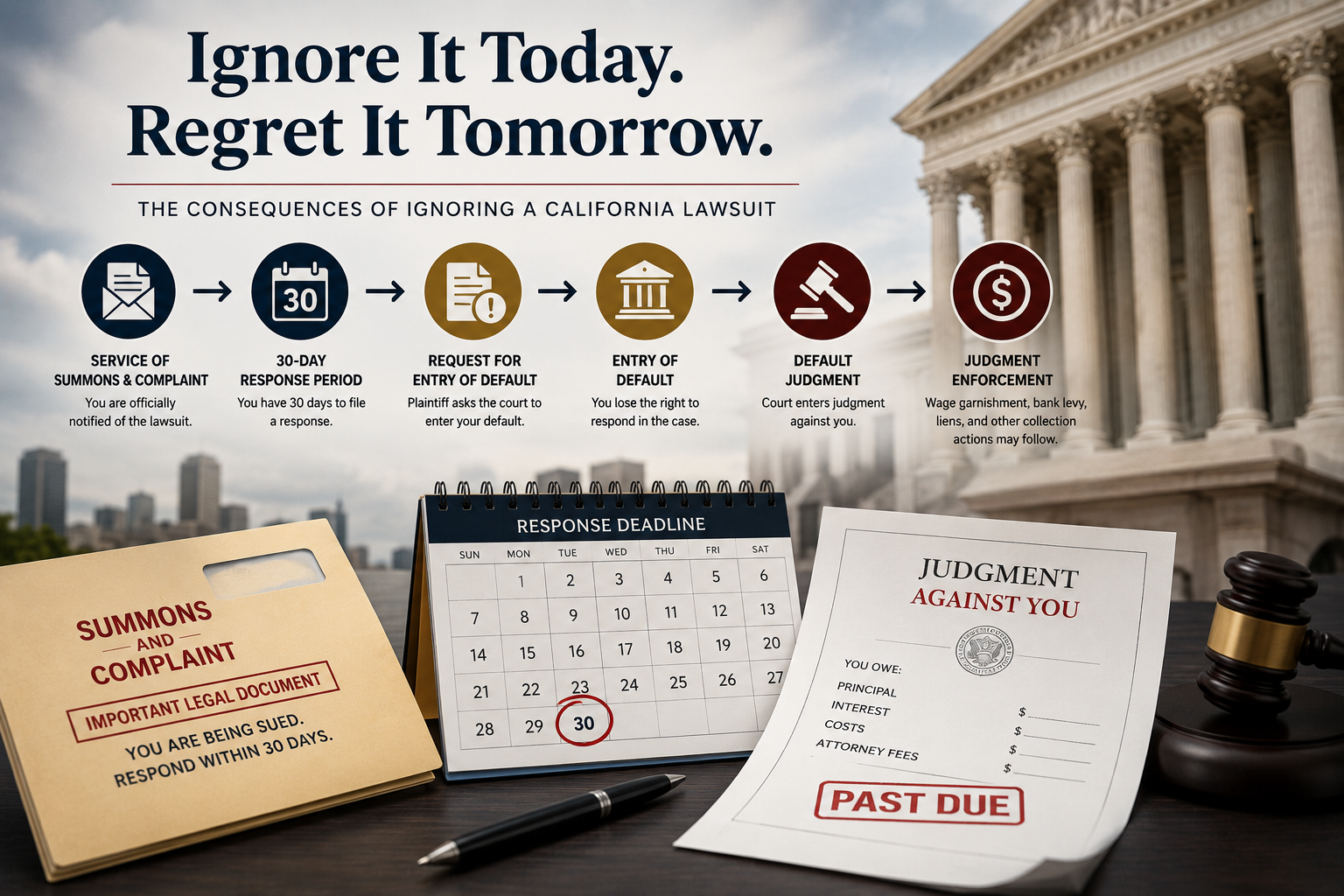
Receiving a lawsuit can be overwhelming. Some people believe the lawsuit has no merit and assume it will simply go away. Others feel intimidated by the legal process and postpone dealing with it until a later date.
Unfortunately, ignoring a lawsuit is rarely a good strategy.
Under California law, if a defendant fails to respond within the time allowed by law, the plaintiff may ask the court to enter the defendant’s default. If the default is entered and the necessary legal requirements are met, the court may ultimately enter a default judgment against the defendant without the defendant ever presenting a defense.
Understanding how this process works can help litigants protect their rights and avoid consequences that may have long-lasting financial and legal implications.
Important: This article discusses California civil litigation procedures. Different rules may apply in federal court and in the courts of other states.
Does Ignoring a Lawsuit Make It Go Away?
No.
One of the most common misconceptions is that refusing to respond somehow prevents the lawsuit from moving forward.
In reality, California’s civil justice system allows a plaintiff to continue prosecuting the case even if the defendant chooses not to participate.
The court will not automatically dismiss a lawsuit simply because the defendant ignores it.
Instead, California law provides procedures that permit the plaintiff to seek entry of default and, ultimately, a default judgment.
How Long Do You Have to Respond?
In most California civil cases, a defendant generally must file a responsive pleading within 30 days after being served with the Summons and Complaint. See California Code of Civil Procedure sections 412.20(a)(3) and 430.40(a).
The appropriate response depends upon the circumstances and may include an Answer, a Demurrer, a Motion to Strike, a Motion to Quash Service of Summons, or another response authorized by law.
Ignoring the deadline may allow the plaintiff to request entry of your default.
What Is an Entry of Default?
If a defendant fails to timely respond, the plaintiff may request that the court enter the defendant’s default pursuant to California Code of Civil Procedure section 585.
Entry of default is an important procedural event.
Once default has been entered:
- the defendant generally loses the right to file a responsive pleading without first obtaining relief from default;
- the litigation may continue without the defendant’s participation; and
- the plaintiff may proceed toward obtaining a default judgment.
Default is not the same thing as a default judgment—but it is often the first step toward one.
What Is a Default Judgment?
A default judgment is a judgment entered by the court in favor of the plaintiff after the defendant has failed to respond as required by law.
Depending on the nature of the case, the plaintiff may still be required to present evidence establishing entitlement to the requested relief before judgment is entered.
Once entered, however, a default judgment generally has the same legal effect as any other civil judgment.
What Can Happen After a Default Judgment?
A default judgment is not merely a piece of paper.
Depending upon the circumstances, a judgment creditor may pursue lawful collection remedies available under California law.
These may include:
- Wage garnishment.
- Bank levies.
- Judgment liens against real property.
- Liens against certain personal property.
- Examination proceedings to identify assets.
- Other judgment enforcement procedures authorized by California law.
The specific remedies available depend upon the nature of the judgment and the applicable statutes governing enforcement.
Can You Ask the Court to Set Aside a Default?
Sometimes.
California law provides procedures under which a defendant may seek relief from a default or default judgment in appropriate circumstances.
For example, relief may be available where the default resulted from mistake, inadvertence, surprise, or excusable neglect, among other grounds recognized by law. See California Code of Civil Procedure section 473(b).
However, relief is not automatic.
The moving party generally bears the burden of demonstrating that relief is warranted under the applicable statute or legal doctrine.
Because deadlines and procedural requirements apply, defendants should act promptly rather than assuming the court will automatically set aside a default.
Common Reasons Defendants Ignore Lawsuits
Many defaults occur not because defendants intentionally disregard the legal process, but because they misunderstand it.
Common reasons include:
- Believing the lawsuit is frivolous.
- Assuming insurance will automatically handle the case.
- Thinking settlement discussions eliminate the need to respond.
- Waiting too long to consult an attorney.
- Misplacing the court papers.
- Not understanding the legal significance of the Summons.
Regardless of the reason, failing to respond can significantly affect the ability to defend the case.
What Should You Do If You Have Already Missed the Deadline?
Do not assume it is too late.
Although every case is different, prompt action may preserve options that become more limited as time passes.
If you discover that you have missed a filing deadline:
- determine whether default has already been entered;
- obtain copies of the court docket, if necessary;
- preserve all relevant evidence;
- avoid further delay; and
- consult an attorney as soon as possible regarding the available procedural options.
The sooner the situation is addressed, the greater the likelihood that meaningful remedies may still be available.
Practical Tips
If you are served with a California lawsuit:
✓ Read every document carefully.
✓ Calendar your response deadline immediately.
✓ Preserve all relevant evidence.
✓ Notify any applicable insurance carrier.
✓ Do not ignore communications from the court.
✓ Seek legal advice before the response deadline expires.
Final Thoughts
Ignoring a California lawsuit rarely causes the dispute to disappear. Instead, it may allow the plaintiff to obtain procedural advantages that become increasingly difficult to overcome as the case progresses.
Although California law provides mechanisms for seeking relief from defaults in appropriate cases, those remedies are discretionary, subject to statutory requirements, and often require prompt action.
If you have been served with a lawsuit—or believe you may have missed an important deadline—obtaining legal advice as early as possible may help preserve your rights and avoid unnecessary procedural complications.
Frequently Asked Questions
Can I ignore a lawsuit if I know the allegations are false?
No. Even if you believe the lawsuit is completely without merit, you should still respond in accordance with California law. Ignoring the lawsuit may result in entry of default and, ultimately, a default judgment.
Does the plaintiff automatically win if I do not respond?
Not automatically. Depending on the nature of the claim, the plaintiff may still need to satisfy legal requirements before obtaining a default judgment. However, failing to respond significantly limits your ability to defend the case.
Can a default judgment be set aside?
Possibly. California law provides procedures that may permit relief under certain circumstances, including those described in California Code of Civil Procedure section 473(b). Whether relief is available depends on the specific facts and applicable legal standards.
What if I missed the deadline only a few days ago?
Do not delay further. Determine whether a default has already been entered and seek legal advice promptly. Acting quickly may preserve options that become more limited once default or judgment has been entered.