
What Is a Demurrer Under California Law? Understanding One of the First Challenges to a Lawsuit

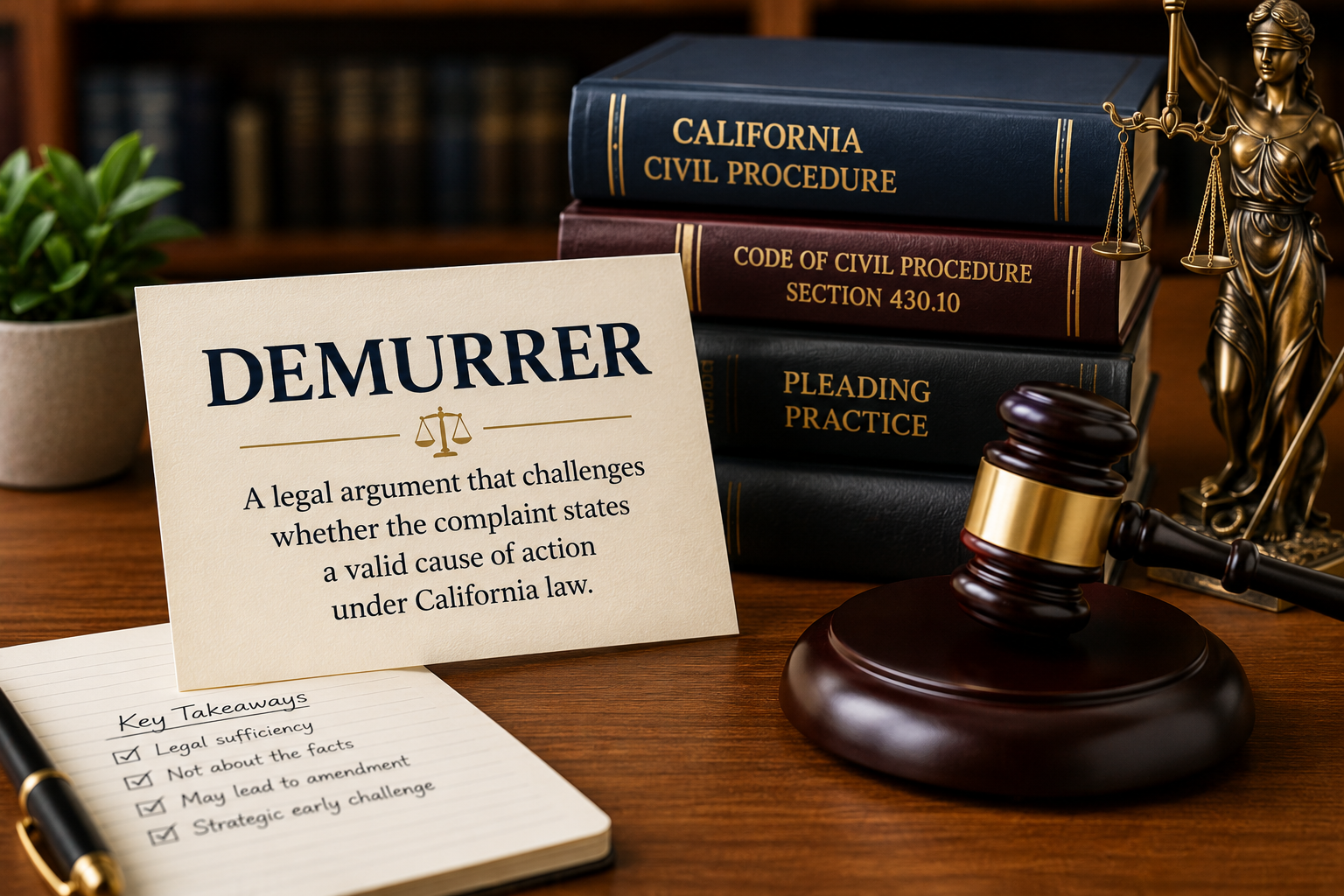
If you have been sued in California—or are considering filing a lawsuit—you may hear your attorney mention a demurrer. Although the term sounds technical, a demurrer serves a relatively straightforward purpose: it asks the court to determine whether the complaint, assuming all of its factual allegations are true, is legally sufficient to state one or more valid causes of action.
In other words, a demurrer generally challenges the legal sufficiency of the pleadings, not whether the plaintiff’s factual allegations are ultimately true.
Understanding what a demurrer is—and what it is not—can help litigants better understand one of the earliest stages of California civil litigation.
Important: This article discusses California civil litigation procedures. Different rules apply in federal court and in the courts of other states.
What Is a Demurrer?
A demurrer is a pleading authorized by the California Code of Civil Procedure that allows a party to challenge defects appearing on the face of the complaint or matters that may properly be judicially noticed.
The statutory grounds for a demurrer are primarily set forth in California Code of Civil Procedure section 430.10.
Unlike a motion for summary judgment, a demurrer generally does not ask the court to weigh evidence, determine witness credibility, or decide disputed facts.
Instead, the court asks a different question:
Assuming everything alleged in the complaint is true, has the plaintiff alleged facts that constitute a legally recognized cause of action?
If the answer is no, the court may sustain the demurrer.
A Demurrer Does Not Mean the Plaintiff Is Wrong
One of the biggest misconceptions is that filing a demurrer means the defendant is arguing the plaintiff is lying.
That is generally not what a demurrer does.
For purposes of ruling on a demurrer, the court ordinarily assumes that properly pleaded factual allegations are true.
The issue is whether those alleged facts, if proven, would entitle the plaintiff to relief under California law.
For example, a complaint may describe a dispute in great detail but still fail to allege one or more legally required elements of a cause of action. In that situation, a demurrer may be appropriate even if every factual allegation is assumed to be true.
Common Grounds for a Demurrer
California Code of Civil Procedure section 430.10 identifies several grounds upon which a defendant may demur to a complaint. Some of the more common grounds include:
- The complaint does not state facts sufficient to constitute a cause of action.
- The court lacks subject matter jurisdiction.
- The plaintiff lacks legal capacity to sue.
- Another action is pending between the same parties on the same cause of action.
- There is a defect or misjoinder of parties.
- The pleading is uncertain, ambiguous, or unintelligible.
Not every ground applies in every case, and determining whether a demurrer is appropriate requires careful review of both the complaint and the applicable law.
What Happens If the Court Sustains a Demurrer?
If the court sustains a demurrer, it agrees that the complaint is legally deficient.
That does not necessarily mean the lawsuit is over.
In many cases, the court grants the plaintiff leave to amend, allowing the plaintiff an opportunity to file an amended complaint correcting the identified deficiencies.
California courts generally favor resolving cases on their merits and frequently allow amendment where there is a reasonable possibility that the defects can be cured.
What Happens If the Court Sustains a Demurrer Without Leave to Amend?
Sometimes the court concludes that the legal defects cannot be corrected through amendment.
In those circumstances, the court may sustain the demurrer without leave to amend.
If that occurs as to all causes of action against a defendant, the result may ultimately be a judgment of dismissal in favor of that defendant.
Whether leave to amend should be granted often becomes one of the most significant issues argued during the hearing.
What Happens If the Court Overrules a Demurrer?
If the court overrules the demurrer, the litigation simply moves forward.
The defendant must generally file an Answer or other responsive pleading within the time prescribed by the California Rules of Court and the Code of Civil Procedure.
The parties then continue with discovery, motion practice, settlement discussions, and, if necessary, trial.
An unsuccessful demurrer does not determine who ultimately wins the case.
Is a Demurrer the Same as a Motion to Dismiss?
Not exactly.
Many people are familiar with the phrase “motion to dismiss” from television or federal court practice.
California civil procedure differs in important respects.
Although both procedures challenge the legal sufficiency of the plaintiff’s claims, California generally uses the demurrer procedure authorized by the Code of Civil Procedure rather than the federal Rule 12(b)(6) motion to dismiss.
Understanding these procedural differences is one reason why state-specific legal advice is important.
Can Every Complaint Be Challenged by Demurrer?
No.
A demurrer is appropriate only when one or more statutory grounds exist.
In many lawsuits, the complaint adequately alleges legally sufficient causes of action, even if the defendant strongly disputes the facts.
In those situations, the appropriate response may be an Answer denying the allegations and asserting affirmative defenses rather than filing a demurrer.
The decision requires careful legal analysis and should not be based solely on whether the defendant believes the lawsuit lacks merit.
Practical Considerations
Although demurrers can be valuable litigation tools, they are not appropriate in every case.
Before filing a demurrer, an attorney typically evaluates questions such as:
- Does the complaint adequately plead every required legal element?
- Can the identified defects realistically be cured through amendment?
- Will a demurrer narrow the issues or simply delay the litigation?
- Would filing an Answer better serve the client’s objectives?
- Are there strategic reasons to challenge only certain causes of action?
Effective litigation often involves considering both the legal merits and the practical consequences of a particular procedural strategy.
Final Thoughts
A demurrer is one of the earliest procedural tools available in California civil litigation for challenging the legal sufficiency of a complaint. It does not decide whether the plaintiff’s allegations are true. Instead, it asks whether those allegations, if assumed to be true, are legally sufficient to state a claim upon which relief may be granted.
Whether filing a demurrer is the appropriate strategy depends on the specific allegations, the applicable law, and the objectives of the parties. Because procedural decisions made early in litigation can significantly affect the course of a case, it is often beneficial to seek legal advice before deciding how to respond to a lawsuit.
Frequently Asked Questions
Does filing a demurrer mean I win the case?
No. A demurrer challenges the legal sufficiency of the complaint. Even if it is sustained, the plaintiff is often given an opportunity to amend the complaint.
Can new evidence be submitted with a demurrer?
Generally, no. A demurrer ordinarily tests the sufficiency of the pleadings rather than the evidence, although the court may consider matters that are properly subject to judicial notice.
What happens if the judge overrules the demurrer?
The case generally proceeds, and the defendant must typically file a responsive pleading, after which the litigation continues through discovery and other pretrial proceedings.
Can only defendants file demurrers?
While demurrers are most commonly filed by defendants in response to a complaint, California procedure also permits demurrers to other pleadings in certain circumstances as authorized by the Code of Civil Procedure.