
USCIS’s New Adjustment of Status Policy: What Every Green Card Applicant Needs to Know


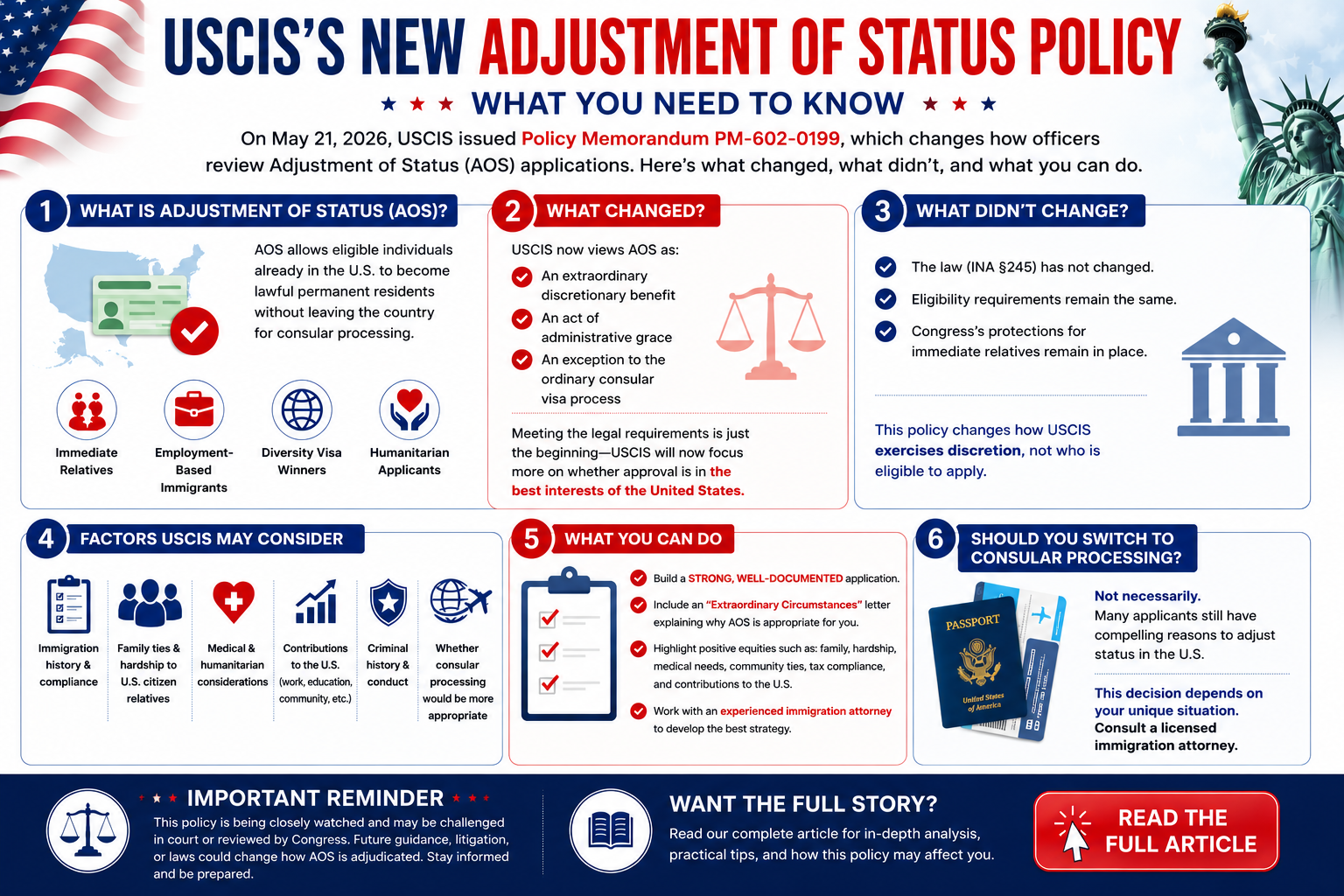
On May 21, 2026, U.S. Citizenship and Immigration Services (USCIS) issued a policy memorandum that has generated significant concern throughout the immigration community. The new USCIS policy memo PM-602-0199) entitled U.S. Citizenship and Immigration Services Will Grant ‘Adjustment of Status’ Only in Extraordinary Circumstances quickly sent shockwaves through the world of immigration. Apart from the uncertainty surrounding this new policy memo and its implementation, there is a lot of confusion surrounding it.
Headlines quickly appeared suggesting that adjustment of status (AOS) had become much more difficult or that applicants would now be required to pursue immigrant visas abroad. While the new policy is certainly important, much of the discussion on social media has lacked nuance. The reality is more complicated. The new USCIS policy memo cites the following authorities at the very outset:
• INA § 103(a)(3); 8 U.S.C. § 1103(a)
• INA § 245(a); 8 U.S.C. § 1255(a)
Many decisions are cited in the memo including Matter of Blas, 15 I&N Dec. 626, 628 (BIA 1974; A.G. 1976), aff’d, 556 F.2d 586 (9th Cir. 1977).
If you are planning to apply for a green card from within the United States, understanding what this policy does—and just as importantly, what it does not do—can help you prepare a stronger application. While the world of immigration is evolving dynamically and in real time, here are some helpful pointers.
What Is Adjustment of Status?
Adjustment of Status (AOS) allows certain individuals who are already lawfully present in the United States to become lawful permanent residents without leaving the country for consular processing abroad.
For decades, adjustment of status has been one of the most common paths to obtaining a green card for eligible applicants, including:
- Immediate relatives of U.S. citizens
- Employment-based immigrants
- Diversity visa winners
- Certain humanitarian applicants
The statutory eligibility requirements under INA §245 have not changed.
What Changed?
The May 21, 20
26 memorandum does not amend the Immigration and Nationality Act.
Instead, USCIS announced that officers should treat adjustment of status as:
- an extraordinary discretionary benefit;
- an act of administrative grace; and
- an exception to the ordinary process of obtaining an immigrant visa through a U.S. consulate abroad.
The memorandum instructs officers to conduct a broader discretionary analysis before approving an adjustment application.
In other words, meeting the legal requirements may no longer be the end of the analysis.
Eligibility vs. Discretion: The Most Important Distinction
One of the biggest misconceptions surrounding the new policy is that it changes who is legally eligible for adjustment.
It does not.
As one legal analysis observed, the memorandum “does not change statutory eligibility rules” but instead “reframes the discretionary baseline for AOS adjudication.” Eligibility remains the threshold; discretion becomes the focus of adjudication.
Think of it this way:
Eligibility asks:
Can you legally apply?
Discretion asks:
Should USCIS approve your application rather than require immigrant visa processing abroad?
Those are different questions.
What Factors will USCIS Consider?
According to the memorandum, officers may consider numerous factors when deciding whether to exercise discretion favorably, including:
- immigration history;
- compliance with immigration laws;
- criminal history;
- family ties within the United States;
- humanitarian considerations;
- contributions to the United States;
- community involvement;
- hardship to U.S. citizen family members;
- national interest considerations; and
- whether consular processing would be more appropriate.
Each application must be evaluated under the totality of the circumstances.
Does This Mean Everyone Should Choose Consular Processing Instead?
No.
Many applicants remain excellent candidates for adjustment of status.
However, applicants should be prepared to explain why adjustment within the United States is appropriate under their individual circumstances.
That is a significant practical change.
Special Considerations for Marriage-Based Green Cards
Immediate relatives of U.S. citizens remain eligible to adjust status under INA §245.
Congress has expressly exempted many immediate relatives from several of the adjustment bars that apply to other applicants, including certain unlawful presence and unauthorized employment provisions. The recent memorandum does not change those statutory exceptions, although it suggests USCIS may consider some of the underlying conduct as part of its discretionary analysis. Legal commentators have noted that this creates tension between Congress’s statutory framework and the agency’s new discretionary approach.
For couples filing marriage-based cases, this means the focus should extend beyond proving that the marriage is genuine.
Applicants should also be prepared to present the positive equities supporting a favorable exercise of discretion.
What About H-1B, L-1, and Other Dual-Intent Visa Holders?
The memorandum specifically recognizes that H-1B, L-1, and certain other nonimmigrant classifications permit dual intent.
This is good news.
Applying for adjustment of status while maintaining H-1B or L-1 status is not inconsistent with those visa classifications.
However, USCIS also states that maintaining lawful dual-intent status alone is not sufficient to justify a favorable exercise of discretion. Applicants should still demonstrate why adjustment within the United States is appropriate.
Practical Ways to Strengthen an Adjustment of Status Application
Based on the memorandum and current adjudication trends, applicants should consider presenting evidence demonstrating positive discretionary factors whenever appropriate.
Depending on the case, these may include:
- Strong evidence that the marriage is bona fide.
- Medical hardship affecting U.S. citizen family members.
- Psychological evaluations where supported by the facts.
- Community involvement and volunteer activities.
- Charitable contributions.
- Evidence of tax compliance.
- Professional achievements.
- Scientific, educational, or business contributions benefiting the United States.
- Employer letters explaining the importance of the applicant’s continued presence.
- Evidence showing why departure for consular processing would create significant hardship.
Not every case will include all of these factors, but thoughtful documentation can help present a complete picture of the applicant’s equities.
Is the Policy Being Challenged?
Yes.
The memorandum has generated significant discussion within the immigration bar.
Some legal commentators argue that the policy alters decades of adjudicative practice by changing how USCIS exercises its discretion, even though the statutory eligibility requirements remain unchanged.
In addition, Senator Ruben Gallego requested that the U.S. Government Accountability Office determine whether the memorandum should be treated as a “rule” under the Congressional Review Act because of its prospective effect on adjustment adjudications.
Whether future litigation, congressional action, or additional agency guidance will modify the policy remains to be seen.
Does This Mean Adjustment of Status Is No Longer Worth Pursuing?
Not necessarily.
Many applicants continue to possess compelling equities that strongly support adjustment of status within the United States.
The new policy simply means that applicants—and their attorneys—should devote greater attention to explaining why a favorable exercise of discretion is warranted rather than relying solely on statutory eligibility.
Every immigration case is unique, and whether adjustment of status or consular processing is the more appropriate path depends on your individual facts, immigration history, and long-term objectives. This decision should be made after careful consultation with a licensed immigration attorney who can evaluate your specific circumstances. Recent policy developments also serve as an important reminder that immigration law has become increasingly complex. What may once have appeared to be a straightforward filing now often requires careful legal analysis, strategic planning, and a thorough understanding of evolving statutes, regulations, agency policies, and case law. For many applicants, immigration is no longer a do-it-yourself process but one in which experienced legal guidance can help identify potential issues, develop a sound strategy, and present the strongest possible case.
Our Approach
Every adjustment of status case is unique.
When appropriate, our office now evaluates whether a case would benefit from a separate memorandum addressing discretionary factors, including:
- family unity;
- humanitarian concerns;
- medical or psychological hardship;
- community involvement;
- employment and economic contributions;
- scientific or professional achievements;
- national interest considerations; and
- other positive equities supported by the evidence.
Preparing a thoughtful, well-documented application at the outset may reduce the likelihood of unnecessary delays or requests for additional evidence.
Final Thoughts
Although the May 21, 2026 memorandum represents a notable shift in how USCIS describes adjustment of status, it is important not to panic. The law governing who is eligible to adjust status has not changed. What has changed is the emphasis on discretionary factors and the expectation that applicants affirmatively demonstrate why adjustment within the United States is appropriate.
If you are considering filing an adjustment of status application—or if you already have one pending—this is an appropriate time to review your case with experienced immigration counsel. A careful assessment of your positive equities and supporting evidence can make a meaningful difference under USCIS’s current approach.