
California Statute of Limitations: How Long Do You Have to File a Lawsuit?

One of the most common misconceptions people have after suffering an injury or experiencing a legal dispute is that they can file a lawsuit whenever they are ready. Unfortunately, California law does not work that way.
Every civil lawsuit is governed by a statute of limitations—a legal deadline established by the Legislature that determines how long a person has to bring a claim before the courts. If that deadline expires before a lawsuit is filed, the claim may be permanently barred, regardless of how strong the underlying case may be.
Understanding these deadlines is one of the most important aspects of protecting your legal rights.
What Is a Statute of Limitations?
A statute of limitations is a law that establishes the maximum period within which a lawsuit must be commenced after a legal claim accrues.
The purpose of these statutes is to promote fairness by encouraging claims to be filed while evidence remains available, witnesses’ memories are still fresh, and relevant documents can be preserved.
In California, the statutes of limitations governing many civil actions are found in California Code of Civil Procedure sections 312 through 365.
Why Is the Filing Deadline Different for Every Case?
There is no single statute of limitations that applies to every lawsuit.
Instead, the applicable deadline depends upon the cause of action being asserted. A cause of action is the legal basis for your lawsuit—for example, negligence, breach of contract, or damage to personal property.
Because different legal rights are protected by different statutes, California law assigns different filing deadlines to different types of claims.
Determining the correct statute of limitations therefore begins with identifying the proper cause of action under California law.
Common California Statutes of Limitations
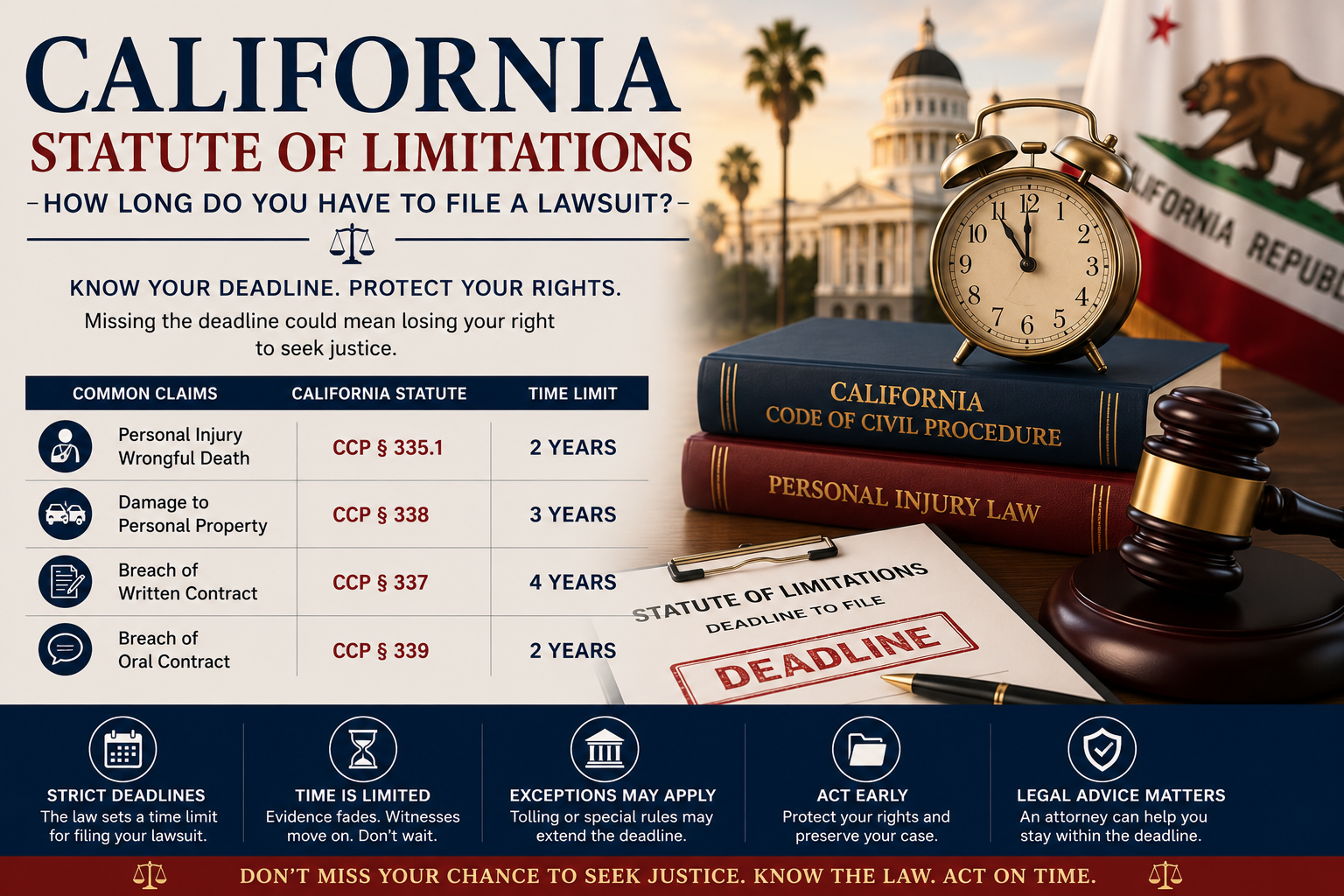
Although every case must be analyzed individually, some of the most frequently encountered statutes of limitations include:
| Cause of Action | California Statute | Limitations Period |
|---|---|---|
| Personal Injury | Cal. Code Civ. Proc. § 335.1 | 2 Years |
| Wrongful Death | Cal. Code Civ. Proc. § 335.1 | 2 Years |
| Damage to Personal Property | Cal. Code Civ. Proc. § 338 | 3 Years |
| Breach of Written Contract | Cal. Code Civ. Proc. § 337 | 4 Years |
| Breach of Oral Contract | Cal. Code Civ. Proc. § 339 | 2 Years |
These are among the most common limitations periods encountered in California civil litigation. However, they are by no means exhaustive. Numerous specialized statutes govern claims involving fraud, professional negligence, construction defects, government entities, employment disputes, and many other areas of law.
When Does the Statute of Limitations Begin to Run?
A common question is not simply how long a person has to file suit, but when the clock begins running.
In many cases, the statute of limitations begins on the date the injury or wrongful act occurs.
However, that is not always true.
California recognizes several exceptions under which a claim may accrue at a later date. For example, under the discovery rule, the limitations period in certain cases does not begin until the plaintiff discovers—or reasonably should have discovered—the injury and its cause.
Determining the accrual date can be one of the most heavily litigated issues in a civil lawsuit and often requires careful analysis of both the facts and applicable law.
Can the Statute of Limitations Be Extended?
Sometimes.
California law recognizes circumstances under which the running of the statute of limitations may be tolled, meaning the statutory period is temporarily suspended.
Examples may include:
- Minority of the injured party;
- Legal incapacity;
- Certain statutory exceptions;
- Equitable tolling recognized by California courts; and
- Other circumstances provided by statute or case law.
Whether tolling applies depends entirely on the facts of each case and should never be assumed.
Government Claims Are Different
Claims against government agencies often involve much shorter deadlines.
Before filing a lawsuit against a California public entity, a claimant is generally required to first present an administrative claim under the California Government Claims Act.
Missing these administrative deadlines may prevent a lawsuit from ever being filed, even if the underlying claim would otherwise have merit.
If your potential claim involves a city, county, state agency, public school, or other governmental entity, it is especially important to consult an attorney promptly.
Medical Malpractice Claims Are Subject to Different Rules
Medical malpractice claims deserve special mention because they are governed by a separate statute of limitations and can be significantly more complex than ordinary personal injury cases.
Under California Code of Civil Procedure section 340.5, an action against a health care provider for professional negligence generally must be commenced within three years of the date of injury or one year after the plaintiff discovers, or through the use of reasonable diligence should have discovered, the injury—whichever occurs first. This statute contains additional exceptions and special rules, including provisions applicable to minors and circumstances involving fraud, intentional concealment, or the presence of a foreign body left in the patient’s body.
Because determining the applicable deadline in a medical malpractice case often requires careful legal analysis, individuals who believe they may have been injured by medical negligence should consult an attorney as soon as possible rather than relying on the general two-year statute applicable to many personal injury claims.
What Is Tolling?
Although statutes of limitations establish filing deadlines, California law recognizes circumstances in which the limitations period may be tolled. Tolling simply means that the statutory clock is temporarily suspended, allowing additional time to file a lawsuit.
Tolling does not automatically apply to every case, nor does it permanently extend the statute of limitations. Instead, it is available only under specific circumstances recognized by statute or California case law. Common examples include situations involving minors, individuals who lack legal capacity, certain periods during which the defendant is absent from the state, equitable tolling in appropriate circumstances, or where another statute expressly pauses the running of the limitations period.
Whether tolling applies can significantly affect a filing deadline and is often the subject of legal disputes. Because these rules are highly fact-specific, individuals should avoid assuming that they have additional time to file and instead seek legal advice before relying on a potential tolling doctrine.
Don’t Assume Settlement Negotiations Stop the Clock
Many people believe that because they are negotiating with an insurance company or attempting to resolve a dispute informally, the statute of limitations is automatically paused.
That is generally not the case.
Unless a valid tolling agreement exists or another recognized legal doctrine applies, settlement discussions typically do not suspend the running of the statute of limitations.
Waiting until negotiations fail may leave insufficient time to properly investigate and file a lawsuit before the statutory deadline expires.
Why Waiting Can Hurt Your Case
Even if the statute of limitations has not yet expired, delaying legal action can make proving your case much more difficult.
Over time:
- Witnesses become harder to locate.
- Memories fade.
- Surveillance footage may be erased.
- Physical evidence can disappear.
- Important documents may no longer be available.
Consulting an attorney early allows evidence to be preserved while ensuring that important filing deadlines are not overlooked.
Every Case Deserves an Individual Analysis
Although statutory deadlines provide a useful starting point, determining the correct filing deadline often requires considerably more analysis than simply looking at a chart.
An attorney may need to determine:
- What is the correct cause of action?
- When did the claim legally accrue?
- Does the discovery rule apply?
- Is the statute subject to tolling?
- Are multiple statutes of limitations implicated?
- Does a contractual limitations provision affect the claim?
Because these questions can significantly affect your legal rights, it is important to obtain legal advice before assuming that a particular deadline applies.
Final Thoughts
California’s statutes of limitations serve an important purpose, but they can also produce harsh consequences when deadlines are missed.
Whether your case involves a personal injury, wrongful death, property damage, or breach of contract, identifying the correct statute of limitations is one of the first—and most important—steps in evaluating your legal rights.
If you believe you may have a legal claim, do not wait until the deadline is approaching. An experienced attorney can determine the applicable statute of limitations, evaluate any potential exceptions, preserve important evidence, and help ensure that your claim is timely filed.