
If Your California Personal Injury Case Goes to Trial: A Client’s Guide

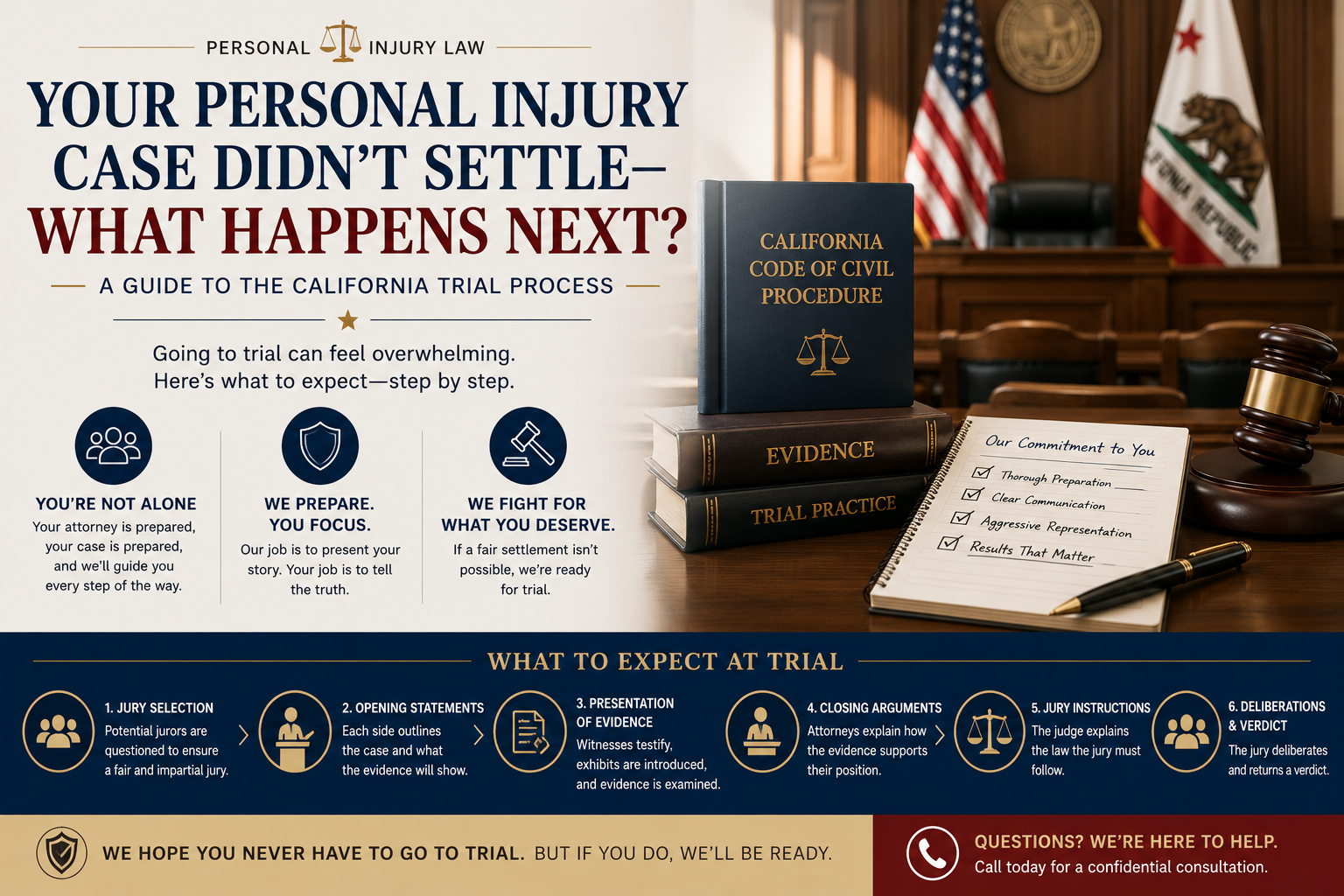
For many people, the thought of going to trial is intimidating.
Television dramas often portray courtroom trials as fast-paced, dramatic confrontations filled with surprise witnesses and emotional speeches. In reality, a California personal injury trial is a carefully structured legal proceeding governed by rules of evidence and civil procedure. While every case is unique, most trials follow a predictable sequence designed to ensure that both sides have a fair opportunity to present their evidence.
The good news is that most personal injury cases never reach trial. Many are resolved through settlement negotiations, mediation, or other forms of alternative dispute resolution before a jury is ever selected. However, when settlement cannot be reached, understanding what to expect can make the process far less overwhelming.
Most Personal Injury Cases Settle Before Trial
Although every case is different, trial is often the final step—not the first.
Throughout litigation, both parties typically continue discussing settlement. Discovery allows each side to evaluate the strengths and weaknesses of the case, and courts frequently require settlement conferences before trial in an effort to encourage resolution.
If settlement efforts are unsuccessful, the case proceeds to trial.
Preparing for Trial
Long before anyone enters a courtroom, significant preparation has already taken place.
During the months leading up to trial, the parties generally exchange documents, answer written discovery, conduct depositions, retain expert witnesses, and file motions addressing legal and evidentiary issues.
Your attorney will also spend considerable time preparing exhibits, organizing medical records, meeting with witnesses, and developing a trial strategy. The better prepared your legal team is before trial begins, the smoother the presentation of your case is likely to be.
Jury Selection (Voir Dire)
If your case will be decided by a jury, the first stage of trial involves selecting jurors.
Potential jurors are questioned by the judge and the attorneys to determine whether they can fairly and impartially decide the case. This process, known as voir dire, is not about selecting jurors who will favor one side. Instead, its purpose is to identify individuals whose experiences or opinions might prevent them from deciding the case solely on the evidence presented in court.
Once the jury has been selected and sworn, the trial formally begins.
Opening Statements
The trial begins with opening statements.
An opening statement is not evidence. Instead, it is each attorney’s opportunity to provide the jury with an overview of what the evidence is expected to show.
The plaintiff’s attorney typically presents the first opening statement, followed by the defense. At this stage, attorneys outline the facts they intend to prove but do not argue the case.
Presentation of Evidence
The plaintiff presents evidence first because the plaintiff bears the burden of proving the case.
Evidence may include:
- testimony from the injured person;
- eyewitness testimony;
- medical records;
- photographs and videos;
- accident reports;
- expert testimony;
- medical bills;
- employment records; and
- other relevant documents.
After each witness testifies, the opposing attorney has the opportunity to cross-examine that witness. Cross-examination is an important part of the adversarial process and allows each side to challenge the testimony presented.
Once the plaintiff has completed the presentation of evidence, the defense presents its own witnesses and exhibits.
Closing Arguments
After all evidence has been presented, both attorneys make closing arguments.
Unlike opening statements, closing arguments allow attorneys to explain how they believe the evidence supports their respective positions.
The plaintiff generally argues why the evidence establishes liability and damages, while the defense explains why the plaintiff has failed to meet the required burden of proof or why damages should be reduced.
Jury Instructions
Before deliberations begin, the judge instructs the jury on the law that applies to the case.
Jurors are required to follow these legal instructions when evaluating the evidence and reaching a verdict. They are not permitted to decide the case based upon sympathy, speculation, or personal opinion.
The judge’s instructions provide the legal framework that guides the jury’s deliberations.
Jury Deliberations and Verdict
Once the jury receives the court’s instructions, jurors retire to deliberate privately.
During deliberations, they discuss the evidence, evaluate witness credibility, and apply the law as instructed by the judge.
When deliberations are complete, the jury returns to the courtroom and the verdict is announced.
If your case is tried before a judge rather than a jury (known as a bench trial), the judge serves as both the finder of fact and the decision-maker.
Will I Have to Testify?
In many personal injury cases, yes.
The injured plaintiff is often one of the most important witnesses.
Your attorney will prepare you thoroughly before trial, including discussing the types of questions you may be asked during both direct examination and cross-examination.
One of the most common concerns clients have is whether they need to memorize testimony. The answer is no. Your responsibility is simply to tell the truth, listen carefully to each question, and answer honestly.
How Long Does a Trial Last?
There is no fixed timetable.
Some personal injury trials conclude in a single day, while others may continue for several weeks depending on the complexity of the case, the number of witnesses, and the amount of evidence presented.
Your attorney can usually provide a reasonable estimate based upon the issues involved in your particular case.
What Happens After Trial?
After the verdict is announced, the case does not necessarily end immediately.
Depending on the outcome, there may be post-trial motions, discussions regarding payment of the judgment, or, in some cases, an appeal. Not every unfavorable verdict is appealed, and an appeal is not a new trial. Rather, an appellate court reviews whether legal errors occurred that may have affected the outcome.
Your attorney will explain your options if post-trial proceedings become necessary.
Should You Be Nervous About Going to Trial?
It is perfectly normal to feel anxious about appearing in court.
For most clients, a trial is an unfamiliar experience. For your attorney, however, trial preparation and courtroom advocacy are part of the legal profession.
One of your attorney’s most important responsibilities is to prepare you for each stage of the process, answer your questions, and present your case in a clear and persuasive manner.
Understanding what to expect often reduces much of the uncertainty surrounding trial.
Final Thoughts
Although the vast majority of California personal injury claims are resolved before trial, every case should be prepared as though it may ultimately be presented to a jury.
Careful preparation, thorough investigation, credible evidence, and effective courtroom advocacy can significantly influence the outcome of a case. If you have questions about the litigation process or are considering filing a personal injury lawsuit, speaking with an experienced attorney early can help you understand your rights and what to expect if your case proceeds to trial.