
Form I-864, Affidavit of Support: Common Mistakes That Can Delay or Derail Your Green Card Case

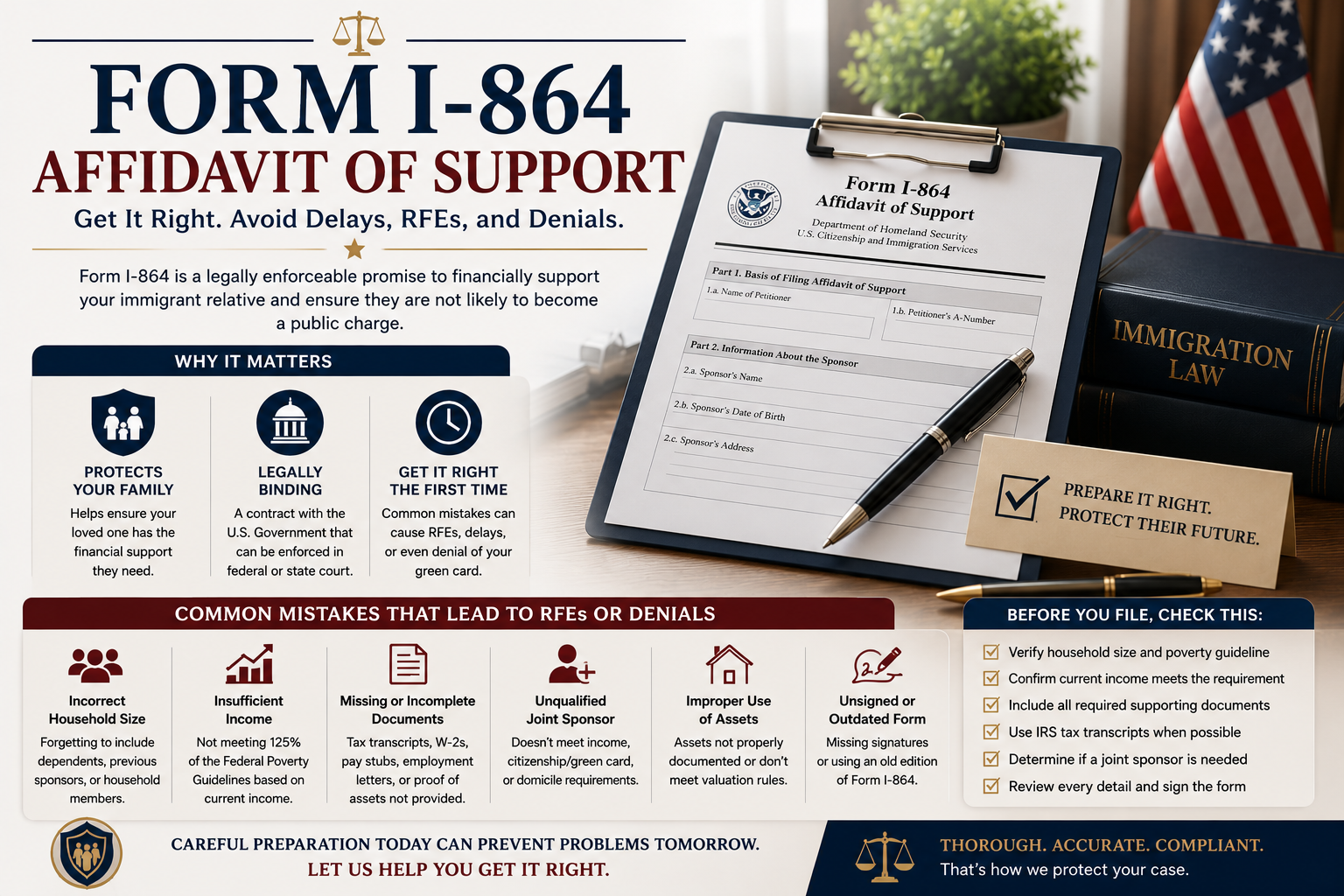
One of the most overlooked parts of a family-based green card application is Form I-864, Affidavit of Support. Yet, it is also one of the most common reasons applicants receive a Request for Evidence (RFE), experience significant delays, or even have their Form I-485 denied.
Many applicants assume that if the petitioner has a job, completing Form I-864 is little more than a paperwork exercise. Unfortunately, that assumption can be costly.
The Affidavit of Support is a legally enforceable contract between the sponsor and the U.S. government. It is designed to ensure that intending immigrants have adequate financial support and are unlikely to become a public charge. For most family-based immigrants—and certain employment-based immigrants where a relative has a significant ownership interest—the Affidavit of Support is a mandatory component of the application. See INA § 213A, 8 U.S.C. § 1183a; 8 C.F.R. § 213a.
Preparing the form correctly requires more than simply filling in numbers. Sponsors must establish that they meet the applicable income requirements, submit the appropriate supporting documentation, and, where necessary, identify a qualified joint sponsor or household member.
What Is Form I-864?
Form I-864 is an Affidavit of Support Under Section 213A of the Immigration and Nationality Act.
By signing the form, the sponsor agrees to maintain the intending immigrant at an income level of at least 125% of the Federal Poverty Guidelines (or 100% for certain sponsors on active duty in the U.S. Armed Forces petitioning for a spouse or child).
This obligation is not merely symbolic—it is legally enforceable in both federal and state courts.
Who Must Submit Form I-864?
In most family-based immigration cases, the petitioning relative must submit Form I-864, even if he or she has no income.
Common examples include:
- U.S. citizen petitioning for a spouse;
- U.S. citizen petitioning for a parent;
- U.S. citizen petitioning for an unmarried or married child;
- Lawful permanent resident petitioning for a spouse or unmarried child.
If the petitioner’s income is insufficient, a qualifying joint sponsor or household member may also need to submit additional forms.
Why Is Form I-864 So Important?
Unlike many immigration forms, the Affidavit of Support is evaluated using objective financial standards.
If USCIS determines that the sponsor has failed to establish financial eligibility, the agency may issue a Request for Evidence or, in some cases, deny the adjustment application if the deficiency is not cured.
The result is often avoidable delay, additional expense, and prolonged uncertainty for the applicant and family.
Common Mistakes That Lead to RFEs
1. Using the Wrong Household Size
One of the most frequent errors involves calculating household size incorrectly.
Sponsors sometimes forget to include:
- themselves;
- the intending immigrant;
- dependent children;
- other dependents claimed on tax returns;
- immigrants previously sponsored where the I-864 obligation continues;
- household members whose income is being counted.
An incorrect household size may cause the sponsor to appear to fall below the required income threshold.
2. Confusing Current Income with Tax Return Income
Many applicants focus exclusively on the income reported on their most recent tax return.
However, USCIS evaluates current individual annual income, not simply historical earnings.
For example, a sponsor who recently changed jobs and now earns substantially more than reflected on the last tax return may still qualify. Conversely, a sponsor who earned sufficient income last year but is currently unemployed may not satisfy the Affidavit of Support requirements without additional evidence.
3. Failing to Submit Required Supporting Documents
Another common reason for RFEs is incomplete documentation.
Depending on the circumstances, USCIS may expect to see:
- IRS tax transcripts;
- W-2s or 1099s where appropriate;
- recent pay statements;
- employment verification letters;
- evidence supporting self-employment income; and
- documentation establishing ownership and value of qualifying assets, if assets are used.
Merely stating an income figure on Form I-864 is generally insufficient.
4. Misunderstanding Asset Requirements
Some sponsors believe they automatically qualify because they own a home or maintain savings.
Assets may be used to supplement income in certain cases, but strict valuation rules apply. Sponsors must establish both ownership and the net value of the assets, and different asset-to-income ratios may apply depending on the immigrant’s relationship to the sponsor.
Not every asset will satisfy the regulatory requirements.
5. Choosing an Unqualified Joint Sponsor
A joint sponsor must independently qualify under the law.
The joint sponsor generally must:
- be at least 18 years old;
- be a U.S. citizen or lawful permanent resident;
- be domiciled in the United States; and
- independently satisfy the applicable income requirement.
Income cannot simply be combined among multiple friends or relatives unless the applicable regulatory requirements are met.
6. Forgetting That the Petitioner Must Still File Form I-864
One of the most common misconceptions is that if a joint sponsor qualifies financially, the petitioning family member no longer needs to complete Form I-864.
That is incorrect.
The petitioning sponsor must generally submit Form I-864 even if he or she has little or no income. The joint sponsor’s affidavit supplements—it does not replace—the petitioner’s obligation.
7. Submitting an Unsigned or Outdated Form
This may seem obvious, but USCIS regularly rejects filings because forms are unsigned or because applicants submit outdated editions of Form I-864.
Always confirm that you are using the current edition published by USCIS and that every required signature has been completed before filing.
Can USCIS Deny a Green Card Because of Form I-864?
Yes.
If USCIS determines that the Affidavit of Support requirements have not been satisfied and the deficiency is not timely corrected, the adjustment application may be denied.
Although USCIS often issues a Request for Evidence before taking that step, applicants should not assume they will always have multiple opportunities to correct errors.
The best approach is to submit a complete and well-documented Affidavit of Support from the outset.