
Your USCIS Case Was Denied—What Are Your Options? Understanding Motions to Reopen and Motions to Reconsider

Receiving a denial notice from U.S. Citizenship and Immigration Services (USCIS) can be discouraging. After months—or sometimes years—of waiting, applicants often wonder whether their immigration journey has come to an end.
In many cases, the answer is no.
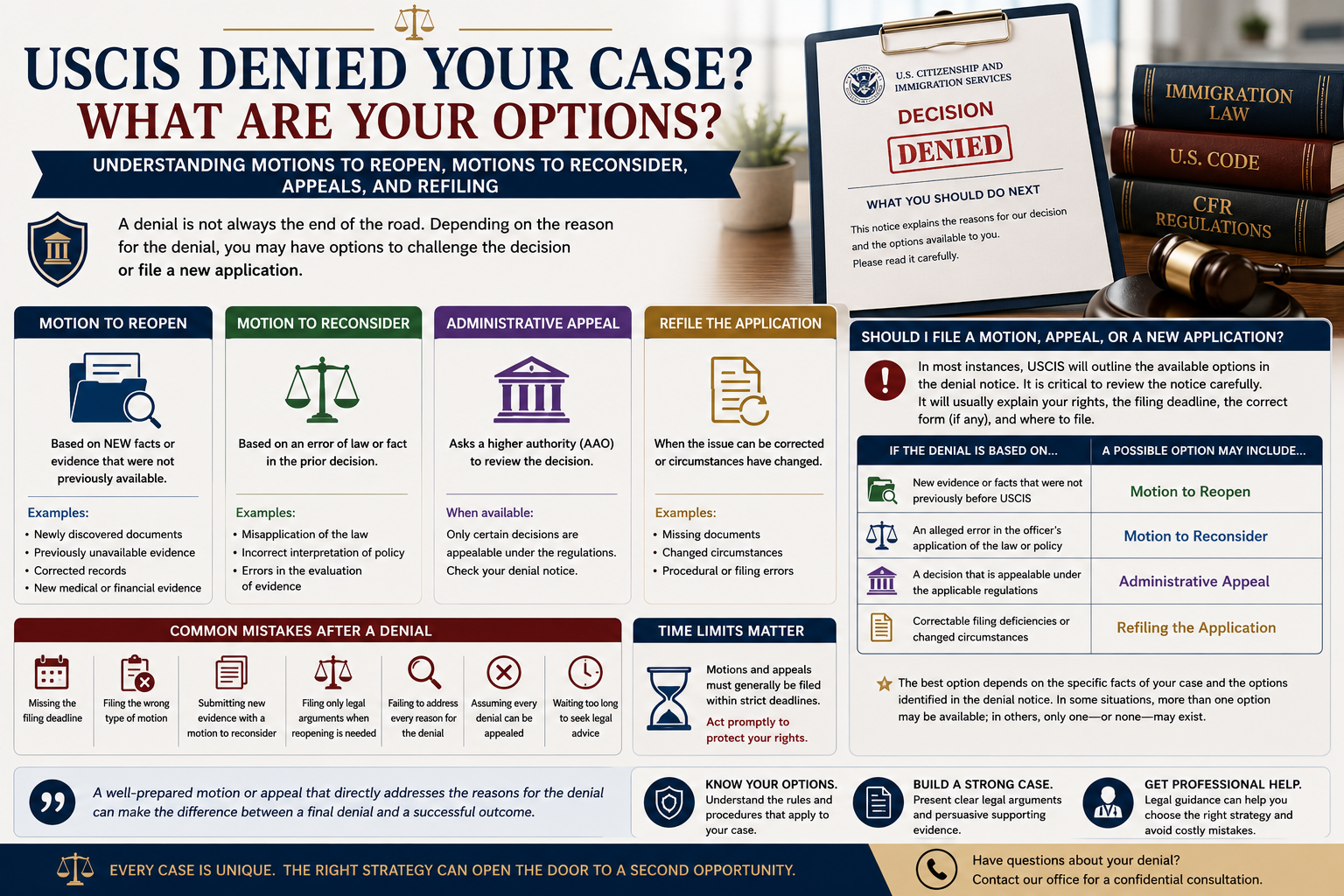
Although some denials require a new filing or an appeal, USCIS regulations also provide a procedure for asking the agency to review its own decision. Depending on the circumstances, an applicant may be able to file a Motion to Reopen, a Motion to Reconsider, or, in some situations, both.
Understanding the differences between these options is critical because each serves a different legal purpose, has different evidentiary requirements, and must generally be filed within strict deadlines.
What Is Form I-290B?
Many motions and administrative appeals are filed using Form I-290B, Notice of Appeal or Motion.
Depending on the type of case and the underlying immigration benefit, Form I-290B may be used to file:
- A Motion to Reopen;
- A Motion to Reconsider; or
- An administrative appeal to the Administrative Appeals Office (AAO), when authorized.
Not every immigration benefit is appealable, and not every denial may be challenged through a motion. The denial notice itself often identifies the available options.
What Is a Motion to Reopen?
A Motion to Reopen asks USCIS to reopen a case because new facts or evidence have become available that were not previously considered.
The governing regulation is found at 8 C.F.R. § 103.5(a)(2).
Unlike an appeal, a Motion to Reopen generally focuses on new evidence, not simply disagreement with the officer’s decision.
Examples may include:
- Newly discovered documents;
- Previously unavailable evidence;
- Corrected civil records;
- Additional financial evidence;
- New medical documentation;
- Evidence addressing issues identified in the denial.
The motion must generally state the new facts to be proven and be supported by affidavits or other documentary evidence.
What Is a Motion to Reconsider?
A Motion to Reconsider serves a different purpose.
Rather than presenting new evidence, it argues that USCIS reached the wrong legal conclusion based upon the evidence that was already in the record.
The governing regulation is 8 C.F.R. § 103.5(a)(3).
A Motion to Reconsider generally identifies:
- Misapplication of statutes;
- Incorrect interpretation of regulations;
- Failure to follow USCIS policy;
- Errors of law; or
- Incorrect application of precedent decisions.
These motions should be supported by citations to statutes, regulations, precedent decisions, or other legal authority demonstrating that the prior decision was legally incorrect.
Can You File Both?
Yes.
In appropriate circumstances, a filing may request both reopening and reconsideration.
For example, an applicant may present newly available evidence while also explaining why the denial was legally erroneous.
Whether both motions are appropriate depends entirely on the facts of the case.
Motion to Reopen vs. Motion to Reconsider
| Motion to Reopen | Motion to Reconsider |
|---|---|
| Based on new facts or evidence | Based on legal or factual error in the prior decision |
| Requires supporting documentation | Relies primarily on legal argument |
| Governed by 8 C.F.R. § 103.5(a)(2) | Governed by 8 C.F.R. § 103.5(a)(3) |
Although the distinction appears straightforward, determining which motion is appropriate often requires careful review of the denial notice.
Is an Appeal Better Than a Motion?
Not necessarily.
Many applicants assume that an appeal is always the preferred option.
That is not true.
An appeal generally asks a higher authority—such as the Administrative Appeals Office—to review the decision.
A motion, on the other hand, asks the same office that issued the denial to reconsider or reopen its decision.
Sometimes a motion is the more efficient remedy.
In other situations, an appeal may be appropriate.
Occasionally, filing a new application may be the best course of action.
The correct strategy depends on the reason for the denial.
When Is Filing a New Application the Better Option?
Not every denial should be challenged.
Sometimes the underlying problem can be corrected simply by filing a new application.
Examples may include:
- Missing required documentation;
- Filing on an outdated form edition;
- Failure to sign the application;
- Incorrect filing fee;
- Circumstances that have materially changed since the original filing.
In these situations, refiling may be more efficient than litigating the prior denial.
Should You File a Motion, an Appeal, or a New Application?
One of the first questions applicants ask after receiving a denial is, “What should I do now?” The answer depends on the reason for the denial, the type of immigration benefit sought, and the procedural options available under the applicable law and regulations.
Importantly, the denial notice itself is usually the best place to begin. In many cases, USCIS will explain the available post-decision options, including whether the decision may be challenged by filing a Motion to Reopen, a Motion to Reconsider, an administrative appeal, or whether the decision is final and no administrative review is available.
For that reason, it is critical to read the denial notice carefully from beginning to end. The notice often identifies the filing deadline, the appropriate form (if any), and the office with jurisdiction over the motion or appeal. Missing these instructions or overlooking an applicable deadline may result in the loss of important rights.
Although every case requires an individualized legal analysis, the following chart illustrates the types of situations in which each option may commonly be considered:
| If the denial is based on… | A possible option may include… |
|---|---|
| Newly available evidence or facts that were not previously before USCIS | Motion to Reopen |
| An alleged error in the officer’s application of the law or USCIS policy | Motion to Reconsider |
| A decision that is appealable under the applicable regulations | Administrative Appeal |
| Correctable filing deficiencies or changed circumstances that make a new filing more appropriate | Refiling the Application or Petition |
This chart is intended only as a general guide. The appropriate course of action depends on the specific facts of each case, the governing statutes and regulations, and the options identified in the denial notice. In some situations, more than one option may be available; in others, only a single procedural remedy—or none at all—may exist.
Common Mistakes After Receiving a Denial
Applicants often make avoidable mistakes immediately after receiving an unfavorable decision.
Some of the most common include:
- Ignoring the filing deadline.
- Filing the wrong type of motion.
- Submitting new evidence with a Motion to Reconsider.
- Filing only legal arguments when a Motion to Reopen is required.
- Failing to address every reason for the denial.
- Assuming every denial can be appealed.
- Waiting too long before seeking legal advice.
A careful review of the denial notice is the first step in determining the appropriate course of action.
Time Limits Matter
Motions generally must be filed within the deadlines established by regulation.
Because those deadlines vary depending on the type of motion and the underlying immigration benefit, applicants should review the denial notice carefully and act promptly.
Missing the filing deadline may eliminate important post-denial options.
Should You File a Motion Without an Attorney?
Some motions are straightforward.
Others involve complex statutory interpretation, evolving agency policy, or intricate factual issues.
When a denial involves questions of eligibility, legal interpretation, fraud allegations, inadmissibility, or discretionary determinations, a carefully researched legal brief supported by statutes, regulations, the USCIS Policy Manual, precedent decisions, and persuasive evidence may significantly strengthen the motion.
Final Thoughts
A USCIS denial is not always the end of an immigration case.
Depending on the reason for the denial, applicants may have several possible options, including filing a Motion to Reopen, a Motion to Reconsider, an administrative appeal, or even submitting a new application.
Because each option serves a different legal purpose and carries different procedural requirements, choosing the appropriate strategy is often just as important as preparing the motion itself.
Carefully analyzing the denial notice, understanding the applicable regulations, and presenting a well-supported legal and factual argument can make a meaningful difference in the outcome of the case.