
EB-1A Recommendation Letters: What Makes a Strong Letter of Support?

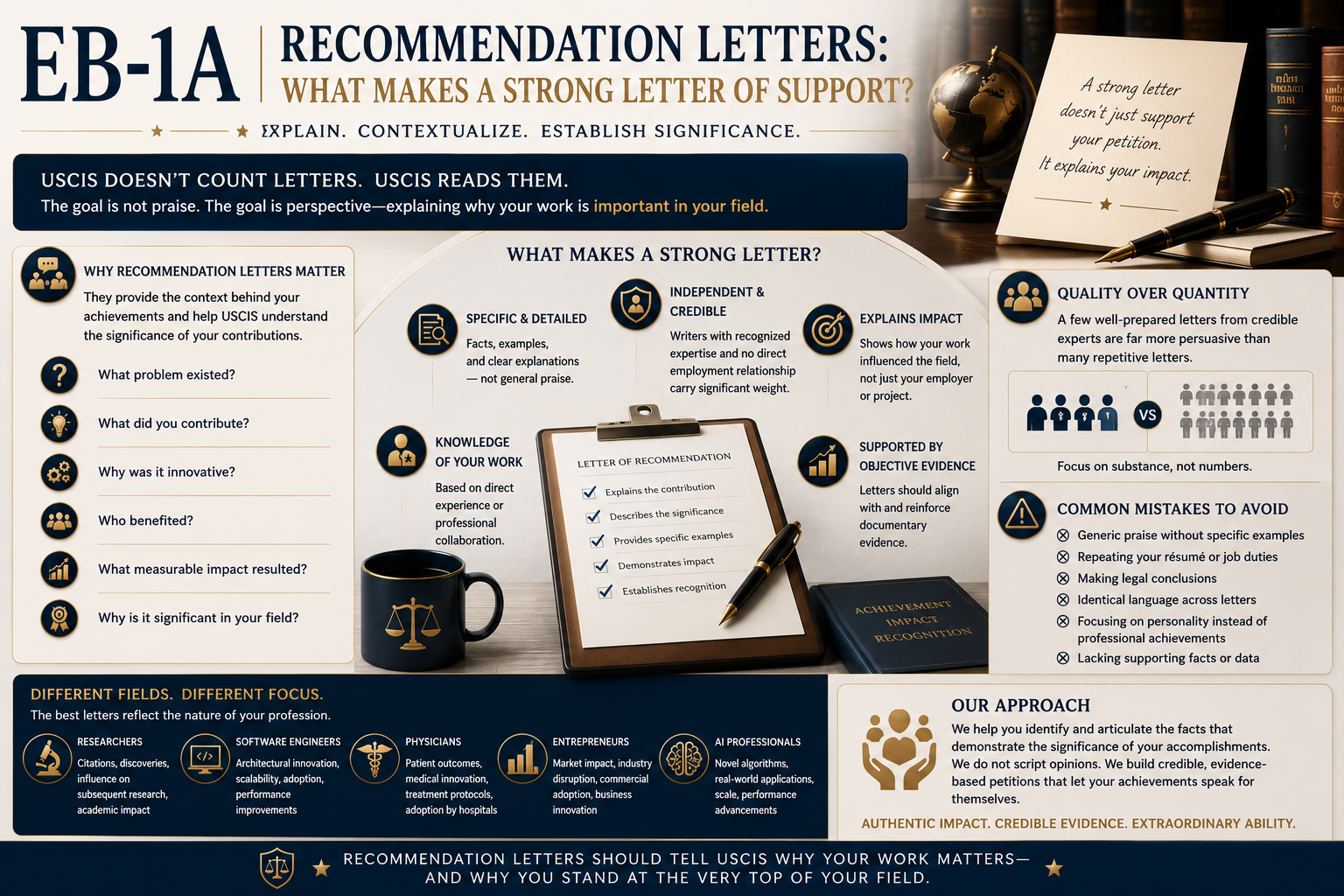
Recommendation letters often play an important role in EB-1A Extraordinary Ability petitions.
However, many applicants misunderstand their purpose.
Some believe obtaining numerous letters automatically strengthens a petition. Others focus primarily on finding well-known individuals to sign letters.
In reality, USCIS is not evaluating recommendation letters based on quantity or prestige alone. Rather, the letters should help explain the applicant’s accomplishments, place those accomplishments in context, and demonstrate why they matter within the profession.
This article discusses the purpose of recommendation letters and the characteristics that often make them persuasive.
Why Are Recommendation Letters Important?
Many professional accomplishments require context.
For example:
- A patent may appear impressive, but what problem did it solve?
- A research publication may have hundreds of citations, but why is that significant?
- A software platform may serve millions of users, but what makes the applicant’s contribution unique?
Recommendation letters help answer these questions.
They provide USCIS with an explanation from knowledgeable individuals familiar with the applicant’s work and the profession.
Independent Experts Often Carry Significant Weight
Although supervisors and colleagues may provide valuable insight, independent experts often provide particularly helpful perspective because they are not directly employed by the same organization.
An independent expert may be able to explain:
- Why the applicant’s work attracted attention.
- How the contribution affected the field.
- Why other professionals recognize the accomplishment.
- The broader significance of the applicant’s work.
This independent perspective may strengthen the overall presentation when supported by objective evidence.
The Letter Should Explain, Not Merely Praise
One of the most common mistakes is writing letters that simply praise the applicant.
Statements such as:
“She is outstanding.”
“He is brilliant.”
“She is one of the best employees I have ever supervised.”
may be sincere, but they do little to explain why the applicant satisfies the legal standard.
A more persuasive letter explains the facts supporting those conclusions.
Strong Recommendation Letters Tell a Story
A well-organized letter often addresses questions such as:
- How does the writer know the applicant?
- What problem existed before the applicant’s work?
- What contribution did the applicant make?
- Why was that contribution important?
- How did others benefit?
- What measurable impact resulted?
- Why is the contribution significant within the profession?
Specific examples are generally more persuasive than broad conclusions.
Credibility Matters
USCIS may consider the credibility and qualifications of the person writing the letter.
Relevant considerations may include:
- Professional experience
- Position within the field
- Familiarity with the applicant’s work
- Basis for the opinions expressed
The most effective letters are supported by concrete facts rather than generalized praise.
Different Professions Require Different Types of Letters
Recommendation letters naturally vary depending upon the applicant’s profession.
For example:
Researchers
Letters may discuss:
- scientific discoveries,
- citations,
- influence on subsequent research,
- collaboration with other institutions.
Software Engineers
Letters may describe:
- architectural innovations,
- adoption of technology,
- measurable performance improvements,
- industry implementation.
Physicians
Letters may explain:
- improved patient outcomes,
- medical innovation,
- treatment protocols,
- adoption by hospitals.
Entrepreneurs
Letters may discuss:
- market impact,
- commercial adoption,
- industry disruption,
- business innovation.
Each profession presents extraordinary ability differently.
Common Mistakes
Recommendation letters sometimes become less persuasive when they:
- Repeat the applicant’s résumé.
- Offer broad praise without examples.
- Make legal conclusions without supporting facts.
- Contain identical language across multiple letters.
- Focus primarily on personality rather than professional accomplishments.
- Describe routine job duties instead of extraordinary achievements.
The strongest letters explain facts.
USCIS draws the legal conclusions.
Recommendation Letters Should Support Objective Evidence
Recommendation letters are important.
However, they are generally most persuasive when they reinforce objective evidence already contained in the petition.
For example:
- patents,
- publications,
- citation records,
- awards,
- media coverage,
- judging activities,
- salary surveys,
- adoption data,
- licensing agreements,
- industry reports.
Objective documentation and well-written recommendation letters often complement one another.
Quality Is More Important Than Quantity
Applicants frequently ask:
“How many recommendation letters do I need?”
There is no fixed number.
A smaller number of well-prepared letters supported by objective evidence is often more persuasive than numerous repetitive letters.
The emphasis should remain on quality, credibility, and substance.
Recommendation Letters Are Part of the Story
Recommendation letters should not simply repeat accomplishments already documented elsewhere in the petition.
Instead, they should explain why those accomplishments matter.
When combined with objective evidence, thoughtful recommendation letters can help USCIS understand the significance of an applicant’s professional achievements and how those achievements contribute to demonstrating extraordinary ability.
Coming Next
In our next article, we will discuss another important aspect of EB-1A preparation:
High Salary and Significantly High Remuneration.
We will explain how USCIS evaluates compensation, why salary comparisons matter, and the types of evidence that applicants commonly submit to support this criterion.
Disclaimer
This article is provided for general informational purposes only and does not constitute legal advice. Every immigration case is unique. Reading this article does not create an attorney-client relationship. Individuals considering an EB-1A petition should consult with a qualified immigration attorney regarding their specific circumstances.